
Hooded eyes have more than one cause
“Hooded eyes” describes the upper eyelid skin appearing to fold down over the crease, but that appearance can come from several different things: brow position, the amount of skin on the upper eyelid itself, underlying fat pad position, or some combination of all three. This matters because only some of these respond to a neuromodulator – the rest are a different conversation entirely.
How a Botox brow lift actually works
This is not a lift in the surgical sense. It works by relaxing the small muscles that pull the eyebrow downward – mainly the corrugator, procerus and the outer part of the orbicularis oculi – which allows the forehead muscle to have slightly more relative lifting effect on the brow. The result is a modest elevation, typically a few millimeters, not a dramatic change.
Worth knowing before booking: this approach works best for hooding that is genuinely related to brow position and muscle pull. If your hooding is mainly caused by excess upper eyelid skin – which is common, especially with age – a neuromodulator will not meaningfully change that, because it does not remove or tighten skin. That is a surgical conversation, specifically blepharoplasty, not an injectable one.
What a realistic result looks like
A subtle opening of the eye area and a slightly more lifted brow position – genuinely worthwhile for the right candidate, but not a substitute for surgery when significant excess skin is the primary cause. An honest assessment before treatment is what determines whether this is the right approach for you specifically, rather than a general answer that applies to everyone who describes their eyes as hooded.
One thing worth being careful about
Some people unconsciously use their forehead muscle to help hold their brows up, especially if brow position has dropped somewhat with age – you may notice this as raised eyebrows even at rest. If the forehead is treated without accounting for this, removing that compensatory lift can occasionally make hooding look worse rather than better. This is exactly why a full assessment of how your brow currently sits, and how it moves, matters more here than in most areas of the face.
How to know if you’re a good candidate
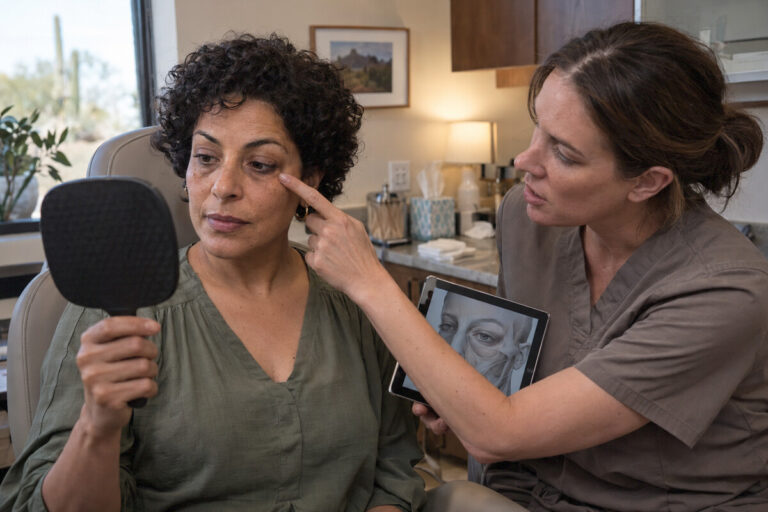
This is genuinely an in-person assessment question rather than something to self-diagnose from a description online. An injector should look at where your brow sits now, how much movement is coming from the forehead versus the muscles being targeted, and how much of your hooding is skin versus position before recommending this approach.
Questions people ask
Can Botox fix hooded eyes?
It can help with hooding related to brow position and muscle pull, providing a modest lift. It cannot address hooding caused mainly by excess eyelid skin, which is a surgical matter.
How much lift does a Botox brow lift actually give?
Typically a few millimeters – a subtle, not dramatic, change.
Could Botox make my hooded eyes worse?
In some cases, if the forehead is treated without accounting for someone’s natural compensatory brow position, hooding can appear worse rather than better. This is why an individual assessment matters.
How do I know if I need Botox or surgery for hooded eyes?
This depends on whether your hooding is mainly caused by brow position or by excess eyelid skin, which needs an in-person assessment to determine.
Want an honest assessment of what would actually help?
A nurse practitioner-led practice in Scottsdale, Arizona.