6 min readUpdated
Forehead Lines: Why They Form and What Helps
A line you only see when you raise your brows and a line that is always there need different plans. What the trials show for forehead lines treatment and how careful planning protects the brows.


If you only read one thing
Forehead lines that appear only when you raise your brows usually respond well to a neuromodulator alone. Botox Cosmetic and Xeomin are FDA-approved for forehead lines, typically 20 units given with 20 units for the frown lines. Lines visible at rest improve more slowly and often need skin treatments as well. Because foreheads move in different patterns, the injection map should be planned for your face to protect brow position.
- Dynamic lines show only with movement; static lines stay at rest and improve more slowly.
- In the Botox forehead trials, 61 and 46 percent reached the strict success target at day 30, vs 0 to 1 percent on placebo.
- Botox Cosmetic and Xeomin are FDA-approved for forehead lines; Dysport and Daxxify use there is off-label.
- Foreheads move in four common patterns, so a custom map protects against brow drop and Spock brows.
- Botox at KORA, forehead lines: $13.50 / unit.
On this page 7 sections
Good forehead lines treatment starts with one question: do your lines show only when you raise your brows, or are they there when your face is still? In this guide I explain why forehead lines form, what the FDA-approved options are and what their trials found, why the forehead needs a custom injection map rather than a standard pattern, and what helps lines that have already set in.
Why forehead lines form
Forehead lines come from the frontalis, the only muscle that lifts the eyebrows, folding the skin every time it contracts. You use it to look surprised, to emphasize a point, and often to hold your brows up without noticing. The American Academy of Dermatology notes that when the same muscles contract repeatedly for years, the lines they make stay visible even at rest.
Sun exposure and smoking speed this up. The AAD recommends a broad-spectrum, water-resistant sunscreen of SPF 30 or higher and says smoking “greatly speeds up how quickly skin ages.” In Arizona, where people hike, golf and run outdoors most of the year, the forehead takes a lot of direct sun, and that sun damage shows in the skin texture between the lines.
Dynamic or static: the mirror test
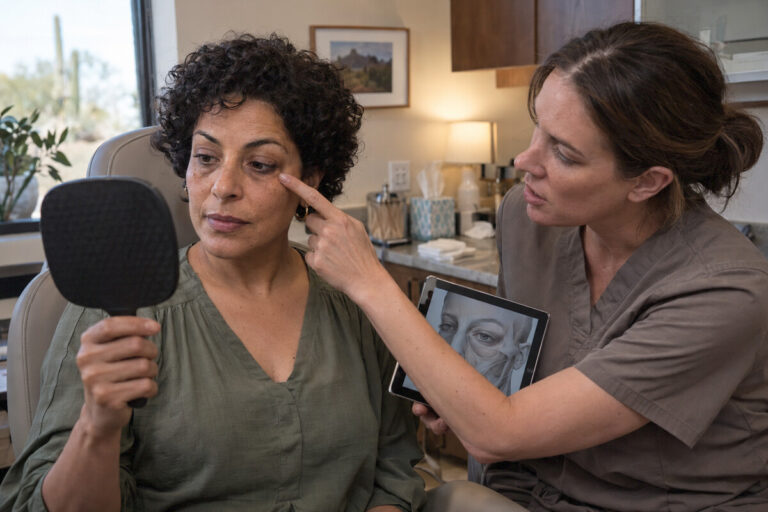
Which type of line you have decides whether a neuromodulator alone will be enough. Look in a mirror with your face relaxed, then raise your eyebrows.
| Dynamic lines | Static lines | |
|---|---|---|
| When you see them | Only when you raise your brows | Even with your face relaxed |
| Skin at rest | Smooth | A crease is still there |
| Usual stage | Earlier | More established |
| What usually helps | A neuromodulator on its own | A neuromodulator plus treatment for the skin itself |
Most people have some of both. The numbers bear this out: in a small 2025 study in the journal Toxins by Frank and colleagues, two weeks after forehead treatment 62.5 percent of patients had no dynamic lines left, while 41.7 percent had no static lines left. Lines at rest improve, but more slowly and less completely.
FDA-approved treatment for forehead lines
Two neuromodulators are FDA-approved for forehead lines: Botox Cosmetic and Xeomin. Both labels give 20 units in five points across the forehead, together with 20 units for the frown lines between the brows, for 40 units in total. In the two Botox trials, 61 and 46 percent of patients reached the strict “none or mild, with at least two grades of improvement” target at day 30, compared with 0 and 1 percent on placebo. Xeomin’s trials, approved in 2024, reported 67 and 58 percent. Those trials used different patients, so the figures are not a head-to-head comparison.
Dysport and Daxxify are FDA-approved for frown lines, and their use on the forehead is off-label, though common. Off-label use is explained before treatment.
The reason the labels pair the forehead with the frown lines matters. The frontalis lifts the brows, and the muscles between and around the brows pull them down. If only the forehead is relaxed, the downward pull wins, and the brows can sit lower. A 2025 review in Aesthetic Surgery Journal Open Forum by Goodman and colleagues recommends treating those brow-lowering muscles at the same time to limit that effect.
Why the forehead needs a custom map
Foreheads move in different patterns, so the same dose in the same five spots does not suit everyone. The Goodman review describes four common patterns of forehead lines:
- Full straight lines (45%)Lines running across the whole forehead.
- Wing-shaped lines (30%)Lines that curve up at the sides, following a muscle with two strong halves.
- Short central lines (10%)Lines mostly in the middle of the forehead.
- Lateral columns (15%)Lines mostly at the outer forehead, above the tail of the brow.
The same review notes that more than 88 percent of people have some brow asymmetry, and that about 5 percent of patients treated with a standard label pattern needed a touch-up for uneven brows. Placement height matters too. The Frank study describes a “line of convergence” on the forehead, below which the frontalis mostly lifts the brow, and recommends keeping injections well above the brow, about 1.5 to 2 centimeters over the bony rim, to protect brow position.
When the plan misses the outer forehead, the outer brows can arch upward, the look patients call Spock eyebrows. When the plan is too strong low on the forehead, the brows can drop, which was reported in 2 percent of patients in the Botox forehead trials and 0.7 percent in Xeomin’s. People who use the forehead to hold up hooded upper lids need particular care, because relaxing that muscle can make the lids feel heavier.
What helps static lines
For lines that show at rest, the neuromodulator is still the first step, because it stops the crease from being folded again every day. The Frank study shows why patients should expect gradual change: static lines improved less in the first two weeks than dynamic ones. For those lines, treatment for the skin itself usually helps as well.
- Daily sun protectionSPF 30 or higher, reapplied outdoors, as the AAD recommends. This protects the improvement you pay for.
- Medical-grade skincareA home routine built for the skin around the lines, which we put together at a skin consultation. See medical-grade skincare.
- Skin-quality treatmentsCollagen-building treatments such as SkinPen PRF microneedling address texture over a series of sessions.
- Filler, in selected casesA very small amount of soft filler is sometimes used for a single etched line, once the muscle has been relaxed.
For timing, our Botox timeline guide explains when results show and how long they last.
What it costs at KORA
Forehead treatment is priced per unit, and most plans include the frown lines as well.
Botox
Forehead lines$13.50 / unit
Dysport
Forehead lines$4.50 / unit
Daxxify
Forehead lines$8 / unit
Prices come from our current price list. Your plan and total are confirmed at a complimentary consultation before anything begins.
Units are not interchangeable between these products, so compare the total for your plan rather than the price per unit. Learn more about Botox and Dysport at our clinic on the Scottsdale and Paradise Valley border.
 BotoxBotox in Scottsdale at KORA Aesthetics — $13.50 per unit, injected by a board-certified nurse practitioner and national clinical trainer. Forehead lines, frown lines, crow's feet, bunny lines, dimpled chin, masseter slimming, neck bands, hyperhidrosis and chronic migraine. See Botox cost per area, how long it lasts, and what to expect at each stage.See treatment, prices and results
Frequently asked questions
How do I get rid of forehead lines?
Lines that show only when you raise your brows respond well to a neuromodulator such as Botox. Lines visible at rest usually need a neuromodulator plus skin treatment, and daily SPF 30 or higher helps prevent new ones.
How many units of Botox are used for forehead lines?
The Botox Cosmetic label uses 20 units across the forehead together with 20 units for the frown lines, 40 units in total. Your plan may differ, and it is set at the consultation.
Why do you treat the frown lines with the forehead?
The forehead muscle lifts the brows and the frown muscles pull them down. Relaxing only the forehead can let the brows drop, so the FDA-approved dosing treats both together.
Can Botox make my eyebrows droop?
It can. Brow droop occurred in 2 percent of patients in the Botox forehead trials. Careful placement well above the brow, and treating the frown muscles at the same time, lowers that risk.
Does Botox get rid of deep forehead creases?
It softens them and stops them deepening, but lines that show at rest improve more slowly. In a 2025 study, 41.7 percent had no static lines two weeks after treatment, compared with 62.5 percent for moving lines.
Is Dysport approved for forehead lines?
No. Dysport and Daxxify are FDA-approved for frown lines; their use on the forehead is off-label. Botox Cosmetic and Xeomin are approved for forehead lines.
How much does forehead Botox cost in Scottsdale?
Botox for forehead lines at KORA Aesthetics: $13.50 / unit. Your total depends on the units in your plan, confirmed at a complimentary consultation.
Sources
- Allergan (AbbVie). BOTOX Cosmetic (onabotulinumtoxinA) prescribing information, revised 10/2024. AbbVie, 2024
- Merz North America. XEOMIN (incobotulinumtoxinA) prescribing information, revised 2/2026. U.S. Food and Drug Administration, 2026
- Goodman GJ, Lim A, Hart S, et al. Botulinum toxin: surely, we can do better? Optimizing results beyond on-label techniques and teaching. Aesthetic Surgery Journal Open Forum, 2025
- Frank K, Prantl L, Brebant V, Haq S. Pilot retrospective evaluation of a balancing and optimizing injection pattern for the frontalis muscle using letibotulinumtoxinA. Toxins, 2025
- American Academy of Dermatology. 11 ways to reduce premature skin aging. AAD, accessed 2026
Katie Manhardt
Board-certified family nurse practitioner and founder of KORA Aesthetics in Scottsdale. Katie is a national clinical trainer for Galderma and Prollenium — selected to teach injection technique and facial anatomy to other medical professionals. Every treatment at KORA is performed by Katie or by one…