
Why crow’s feet form earlier than other lines
The skin at the outer corner of the eye is among the thinnest on the face, which is part of why lines show up here earlier than almost anywhere else. Two repeated movements drive it: smiling, which most people do thousands of times without thinking about it, and squinting against sun, which adds up over decades even without deliberate sun exposure.
That combination – thin skin plus two very frequent movements – is what makes this area distinct from somewhere like the forehead, where a single muscle and a single movement pattern is doing most of the work.
Are yours dynamic or static?
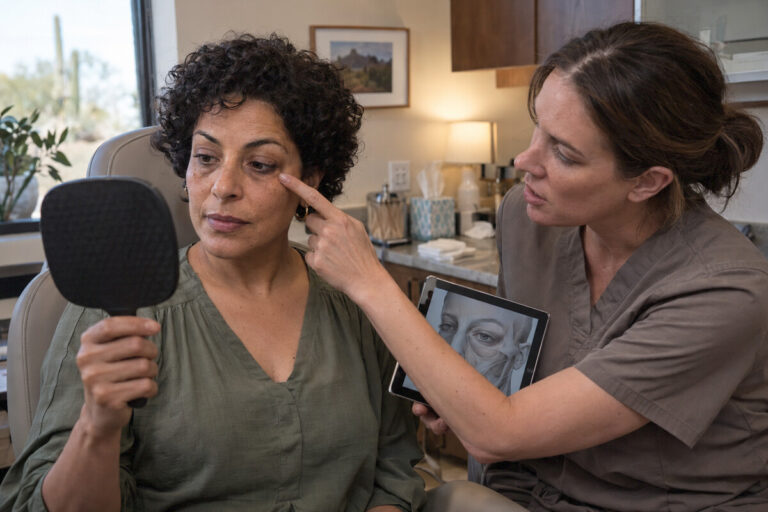
Smile naturally in a mirror, then relax your face completely. What you see in each state matters for treatment.
| Dynamic | Static |
|---|---|
| Only visible when smiling | Faintly visible even at rest |
| Skin looks smooth with a relaxed face | Fine lines persist without any expression |
| Very common, even in younger patients | Usually reflects more accumulated sun exposure or years of the same movement pattern |
| Responds very well to a neuromodulator alone | Often benefits from a neuromodulator plus skin-quality treatment |
What actually treats them
For the dynamic lines that show only on smiling, Botox or Dysport relaxes the muscle causing the fold, and this area typically responds very well – it is one of the more predictable places to treat. See the Botox timeline guide for when to expect results.
For static, fine surface texture that persists at rest, a neuromodulator alone softens it but skin-quality treatment addresses the texture itself more directly. Medical-grade skincare, particularly consistent retinoid use, is genuinely useful here over months, not as a fast fix.
This area needs a lighter touch than most. Because the muscle around the eye also plays a role in a natural smile, conservative dosing matters more here than almost anywhere else on the face. The goal is softened lines with a smile that still looks like a smile – not a fully immobile area. This is a conversation about your specific dose with your injector, not a standard amount applied the same way to everyone.
Preventing new ones
- Sunglasses, genuinely. This is the one area where squinting against sun is a major, avoidable contributor – good sunglasses reduce both UV exposure and the squinting movement itself.
- Daily sun protection on the skin around the eyes specifically, not just the rest of the face.
- Treating dynamic lines before they become static. The same principle that applies to the forehead applies here.
- Consistent retinoid use, appropriate for the eye area specifically since skin here is thinner and more sensitive than elsewhere on the face.
Myths worth dropping
- “Crow’s feet mean your skin is aging badly.”
- They largely reflect thin skin and repeated movement, not overall skin health. Many people develop them relatively young simply because they smile often.
- “Treating this area means you can’t smile properly anymore.”
- With conservative, well-placed dosing, a natural smile is the goal, not a side effect to avoid. An overly frozen look here is a dosing choice, not an inevitable result.
- “Sunglasses alone will stop them from forming.”
- They meaningfully slow it down by reducing squinting and UV exposure, but the smiling movement itself continues regardless, so sunglasses reduce the rate rather than prevent it entirely.
- “Crow’s feet only need to be treated once they’re already deep.”
- Earlier, dynamic-stage treatment is both easier to treat and part of what prevents the static, harder-to-treat stage from developing.
Questions people ask
What causes crow’s feet?
Thin skin around the eyes combined with two frequent movements – smiling and squinting against sun – which fold the skin repeatedly over time.
Does Botox work well on crow’s feet?
Yes, this is one of the areas that typically responds most predictably to a neuromodulator, particularly for dynamic lines that only show when smiling.
Will treating crow’s feet affect my smile?
With conservative dosing, no – a natural smile is the goal. Over-treatment can affect it, which is why this area is typically dosed more lightly than others.
Can skincare alone get rid of crow’s feet?
Skincare and consistent retinoid use help with fine surface texture and prevention over months, but will not relax the underlying muscle movement causing dynamic lines.
Do sunglasses actually help prevent crow’s feet?
Genuinely, yes – they reduce both UV exposure and the squinting motion that contributes to this area more than most others on the face.
Want an assessment of your specific lines?
A nurse practitioner-led practice in Scottsdale, Arizona, priced transparently at $13.50 per unit.