6 min readUpdated
PRF vs PRP for Microneedling: What the Research Shows and Why We Use PRF
How PRF and PRP are made, what lab and clinical studies found when they were compared with microneedling, where the evidence is thin, and why KORA uses PRF.

If you only read one thing
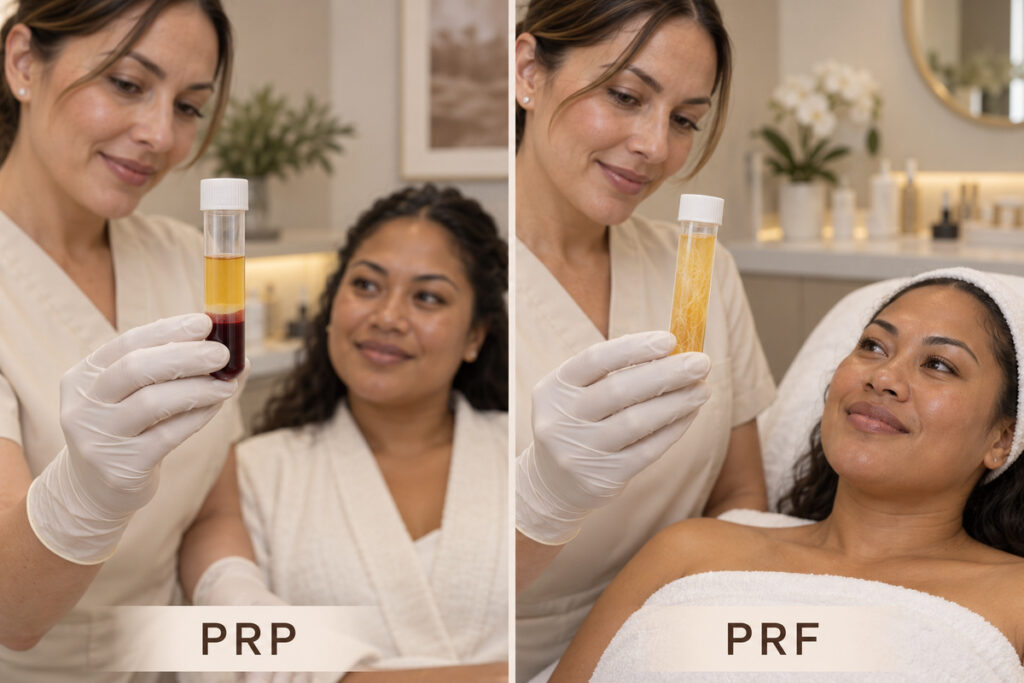
PRF and PRP are both made from your own blood. PRP uses an anticoagulant and a harder spin and releases most growth factors within the first hour. PRF uses no additives and a gentle spin, forms a fibrin gel and releases growth factors steadily over about 10 days in lab testing. Small clinical studies suggest PRF works at least as well as PRP with microneedling; large head-to-head trials are still missing.
- PRP is spun harder with an anticoagulant; PRF is spun gently with nothing added and forms a fibrin gel.
- In a 2016 lab study, PRP released more growth factors in the first hour, while PRF released them steadily over 10 days.
- A 2022 meta-analysis of 472 patients found adding PRP to microneedling made 50%+ acne scar improvement about three times more likely.
- A small 2023 study found fluid PRF scored better than PRP on several measures, but large head-to-head trials are still missing.
- Microneedling with PRF at KORA: $450 per session, PRF included.
On this page 7 sections
PRF vs PRP for microneedling comes down to how your blood is processed and how quickly the growth factors are released into the skin. In this guide I explain how the two are made, what lab and clinical studies have found when they are compared, where the evidence is still limited, and why we pair SkinPen microneedling with PRF at KORA.
How PRF and PRP are made
Both PRF and PRP come from a small sample of your own blood spun in a centrifuge; the difference is what is added to the tube and how hard it is spun. A 2023 study in Archives of Dermatological Research by Diab, Ibrahim and Abdallah describes the two methods it used:
| PRP (platelet-rich plasma) | Fluid PRF (platelet-rich fibrin) | |
|---|---|---|
| Anticoagulant | Yes (EDTA in that study) | None |
| Spin | Two spins: 900 rpm for 5 minutes, then 2000 rpm for 15 minutes | One short spin: about 700 rpm for 3 minutes |
| What forms | A liquid concentrate of platelets | A liquid that turns into a fibrin gel within about 15 to 20 minutes, trapping platelets and white cells |
| Growth factor release | Fast. The authors note about 95% is released shortly after activation | Slow and prolonged, from the fibrin matrix |
Exact protocols vary between systems and clinics, but the principle is the same: PRF is spun more gently, with nothing added, so it clots into a soft scaffold rather than staying liquid.
Growth factor release: what the lab study shows
PRP releases more growth factors in the first hour, while PRF keeps releasing them for days. In a 2016 study in Clinical Oral Investigations, Kobayashi and colleagues measured growth factors released by PRP, PRF and an advanced PRF from six donors at intervals from 15 minutes to 10 days. PRP released significantly more in the first 15 to 60 minutes. PRF showed a steady, continuing release over the full 10 days, and the advanced PRF released the highest total amount over that period. The authors concluded that PRP suits fast delivery and that PRF is better suited to longer release.
This was a lab study of blood samples, not of skin, and it tells us about timing rather than results on a face. It is the reasoning behind our choice, not proof of a better outcome.
What clinical studies show for microneedling
Adding platelets to microneedling
The strongest evidence is for adding either concentrate to microneedling, compared with microneedling alone. A 2022 meta-analysis in Frontiers in Medicine by Kang and Lu pooled 14 studies and 472 patients with acne scars. Adding PRP made a 50 percent or greater improvement about three times more likely (odds ratio 2.97) and raised patient satisfaction, with no significant increase in severe redness or swelling. The authors note that most studies were small and came from India and Egypt.
For PRF, a 2023 split-face study in Dermatologic Surgery treated 40 patients with four monthly sessions of microneedling plus injectable PRF on one side and microneedling plus saline on the other. At 24 weeks, the average scar grade on the PRF side fell from 3.45 to 1.47, and rolling scars responded most.
PRF compared with PRP
Direct comparisons are few and small. In the Diab study, 30 patients with acne scars were split into a PRP group and a fluid PRF group of 15 each, and each patient had injection alone on one side and needling with the same product on the other, for four sessions three weeks apart. PRF, with or without needling, scored better than PRP on the quartile grading scale and on patient satisfaction, and needling improved results with both. On the Goodman and Baron scale the PRF groups improved more, but the difference between PRF alone and PRP alone was not statistically significant. Hyperpigmentation appeared on 20 percent of the needling-plus-PRP sides, and one PRF patient developed a bacterial infection that cleared with antibiotics.
Where the evidence stands: there is good evidence that platelet concentrates add to microneedling for acne scars, lab evidence that PRF releases growth factors more slowly, and early clinical evidence that PRF performs at least as well as PRP. There is no large trial proving PRF gives better skin results. The FDA’s 2025 consumer update also notes that it has not reviewed the safety or effectiveness of combining microneedling with platelet-rich plasma, and the same is true for PRF.
Why we use PRF for microneedling at KORA
We use PRF because its slower release fits the way microneedling works. Microneedling sets off a healing response that unfolds over days and weeks, not minutes. A product that keeps releasing growth factors over several days matches that timeline better than one that releases most of its supply almost at once. PRF is, by definition, made without an anticoagulant, so nothing is added to the blood.
On the day, a small blood sample is drawn from your arm and spun; the draw itself is quick. After the SkinPen pass, the PRF is applied to the skin straight away, while the microchannels are still open.
PRF is also used on its own
The same fibrin-based concentrate can be injected rather than applied to the surface, which is a separate treatment with its own plan. We also offer liquid PRF injections, used in areas such as the under-eyes, and PRF EZ Gel, made by heating part of your plasma into a gel. Ask us about either at your consultation.
What PRF microneedling costs at KORA
Microneedling with PRF is priced per session, and the blood draw and PRF preparation are included.
SkinPen microneedling
Per session$350
Microneedling with PRF
Per session, PRF included$450
PRF injections
Single area$450
Prices come from our current price list. Your plan and total are confirmed at a complimentary consultation before anything begins.
Read more about SkinPen PRF microneedling, which acne scars respond in acne scar types and microneedling, and how to care for your skin afterward in our aftercare guide. We treat patients at our clinic on the Scottsdale and Paradise Valley border.
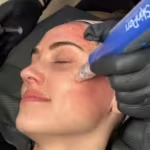 SkinPen PRF MicroneedlingSkinPen microneedling in Scottsdale at KORA Aesthetics — $350 alone or $450 with PRF drawn from your own blood. Acne scarring, texture, enlarged pores and early lines, treated by a nurse practitioner. See how many sessions it takes, what the PRF upgrade actually adds, and the day-by-day recovery.See treatment, prices and results
Frequently asked questions
What is the difference between PRF and PRP?
Both come from your own blood. PRP is spun harder with an anticoagulant and stays liquid; PRF is spun gently with nothing added, so it forms a fibrin gel that releases growth factors more slowly.
Is PRF better than PRP for microneedling?
Early evidence favors PRF. A 2023 study of 30 acne scar patients found fluid PRF scored better on several measures, but the groups were small and some differences were not statistically significant.
Why is PRF released more slowly?
PRF forms a fibrin matrix that traps platelets and white cells, so growth factors are released gradually. In a 2016 lab study, PRF kept releasing them over 10 days, while PRP released more in the first hour.
Does PRF microneedling work for acne scars?
Studies support it. In a 2023 split-face study of 40 patients, the side treated with microneedling and PRF improved from an average scar grade of 3.45 to 1.47 at 24 weeks.
Is PRF microneedling FDA-approved?
SkinPen is FDA-authorized for facial acne scars. The FDA has not reviewed microneedling combined with platelet concentrates such as PRP or PRF.
How long does it take to make PRF?
The blood draw is quick, and the spin itself takes only a few minutes.
How much does PRF microneedling cost in Scottsdale?
At KORA, microneedling with PRF is $450 per session, including the blood draw and PRF preparation. Microneedling alone is $350.
Sources
- Kobayashi E, Fluckiger L, Kobayashi M, Sawada K, Sculean A, Schaller B, Miron RJ. Comparative release of growth factors from PRP, PRF, and advanced-PRF. Clinical Oral Investigations, 2016;20(9):2353-2360
- Diab NAF, Ibrahim AM, Abdallah AM. Fluid platelet-rich fibrin (PRF) versus platelet-rich plasma (PRP) in the treatment of atrophic acne scars: a comparative study. Archives of Dermatological Research, 2023;315:1249-1255
- Kang C, Lu D. Combined effect of microneedling and platelet-rich plasma for the treatment of acne scars: a meta-analysis. Frontiers in Medicine, 2022;8:788754
- Krishnegowda R, Pradhan SN, Belgaumkar VA. A split-face study to evaluate efficacy of autologous injectable platelet-rich fibrin with microneedling against microneedling with normal saline in atrophic acne scars. Dermatologic Surgery, 2023
- US Food and Drug Administration. Microneedling devices: getting to the point on benefits, risks and safety. Consumer update, 2025
Katie Manhardt
Board-certified family nurse practitioner and founder of KORA Aesthetics in Scottsdale. Katie is a national clinical trainer for Galderma and Prollenium — selected to teach injection technique and facial anatomy to other medical professionals. Every treatment at KORA is performed by Katie or by one…