Not all acne scars are the same shape
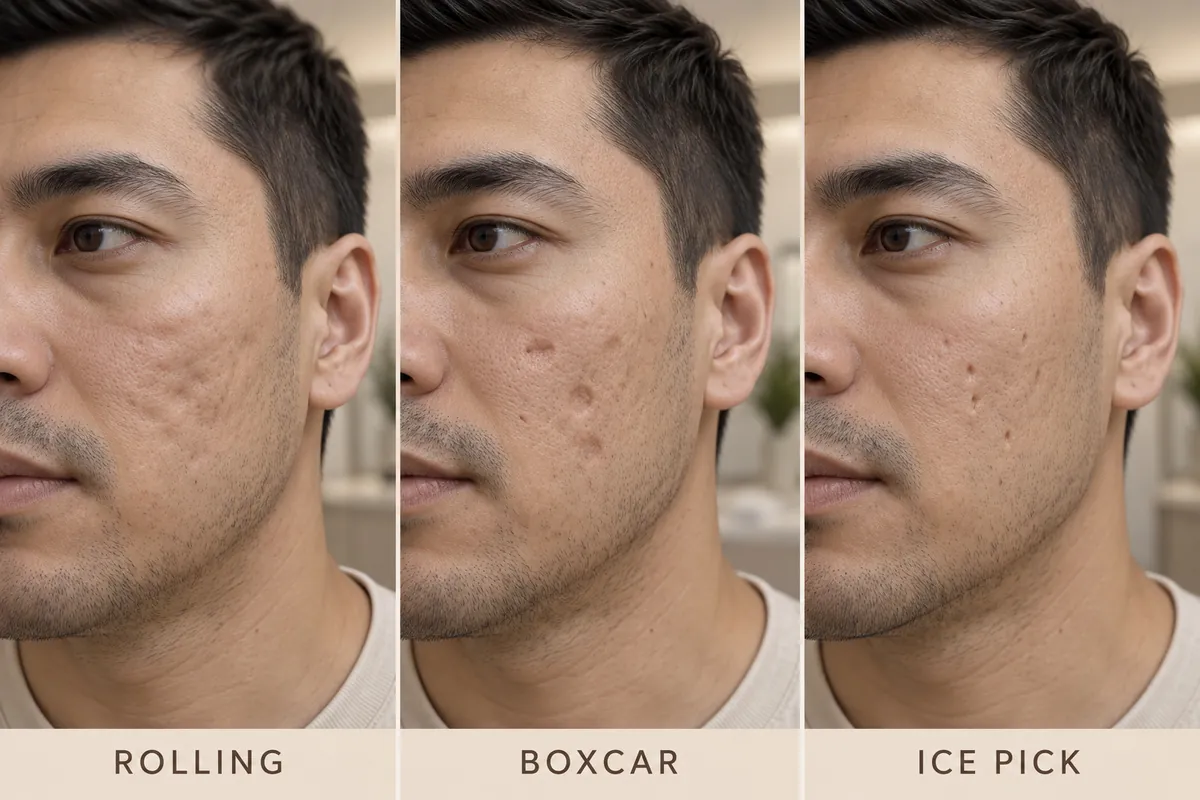
“Acne scars” covers three genuinely different kinds of scarring, and they don’t all respond to treatment the same way. Knowing which one you have is more useful than knowing the general category, because it changes what actually helps.
| Type | What it looks like | Responds to microneedling? |
|---|---|---|
| Rolling scars | Broad, shallow depressions with sloping edges, giving skin a wavy texture | Yes, generally well |
| Boxcar scars | Wider depressions with sharply defined edges, like a shallow crater | Yes, generally well |
| Ice pick scars | Narrow, deep, and tunnel-like – often described as looking like large pores | Usually not on their own |
Why rolling and boxcar scars respond well
Both types involve tissue that has been pulled or depressed but is still relatively close to the surface. Microneedling works by triggering new collagen production in the treated area, and for scars at this depth, that new collagen genuinely fills in and softens the depression over a course of sessions. This is the category of scarring microneedling is best suited for.
Why ice pick scars are different
Ice pick scars go deep and narrow, often extending well below where microneedling’s collagen-stimulating effect reaches. Treating them with microneedling alone typically produces a modest improvement at best. They usually respond better to a targeted approach like subcision, which releases the tethered tissue causing the depression, sometimes combined with other resurfacing treatments. If ice pick scarring is your primary concern, that is worth discussing directly rather than starting with microneedling and hoping.
A simple way to check which you have
Gently stretch the skin taut between two fingers. Rolling scars often become noticeably less visible when the skin is stretched. Boxcar scars tend to stay sharply defined regardless. Ice pick scars look like narrow, deep punctures that don’t change much with stretching. Most people have a combination, which is normal – the point is identifying which type is dominant.
What a realistic treatment plan looks like
If your scarring is mostly rolling and boxcar, a course of microneedling is a reasonable, well-supported starting point – typically 4 to 6 sessions for acne scarring specifically, as covered in Microneedling Aftercare. If ice pick scarring is present alongside the other types, an honest plan often means addressing that piece with a different technique rather than expecting microneedling alone to resolve everything.
Questions people ask
Does microneedling work on all acne scars?
Not equally. It works well on rolling and boxcar scars. Ice pick scars typically need a different approach, like subcision, for meaningful improvement.
How do I know what type of acne scars I have?
Gently stretch the skin taut. Rolling scars often soften with stretching, boxcar scars stay defined, and ice pick scars look like narrow, deep punctures. Most people have a mix, and an in-person assessment is the most reliable way to know for sure.
How many sessions does acne scarring need?
Typically 4 to 6 sessions, more than the 3 to 4 usually needed for general texture and glow.
What if I have ice pick scars?
Microneedling alone usually produces limited improvement on ice pick scars specifically. Subcision or another targeted technique is generally the better first step for that particular type.
Not sure which type of scarring you’re dealing with?
A nurse practitioner-led practice in Scottsdale, Arizona.