5 min readUpdated
Jelly Roll Botox: Muscle Bulge or Under-Eye Bags?
A muscle bulge that shows when you smile is not the same as under-eye bags, and only one responds to Botox. How to tell, the risks, and what else helps.

If you only read one thing
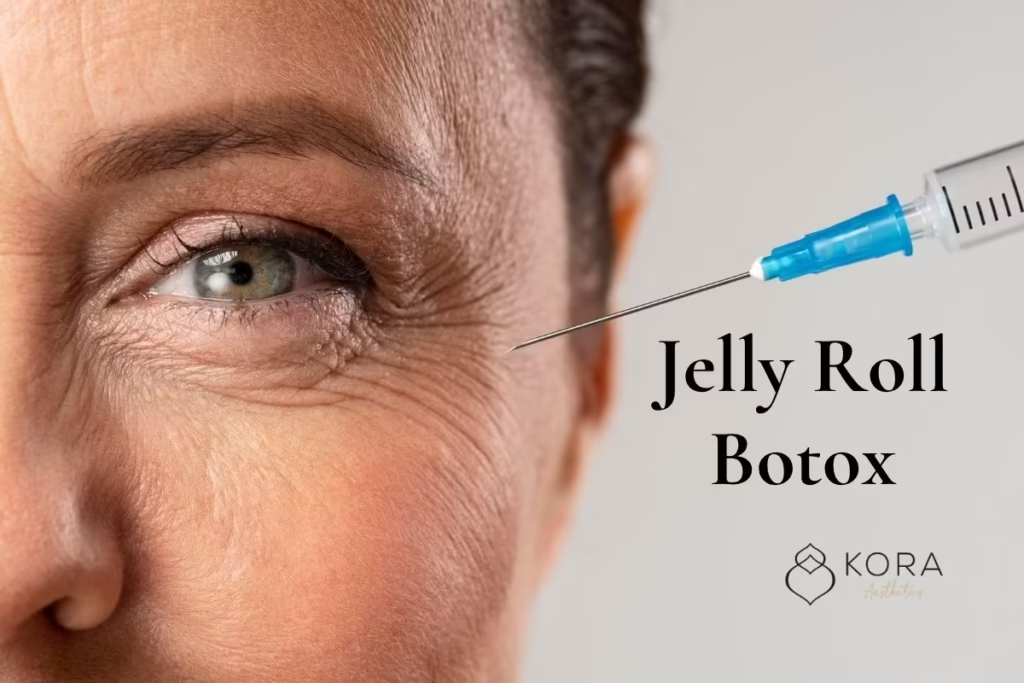
Jelly roll Botox uses a very small dose, around 2 units per lower eyelid in early studies, to soften a muscle bulge that appears under the lashes when you smile. It is off-label: the FDA-approved eye area is crow's feet. It does not treat under-eye bags caused by fat, and it is not suitable for people with lax lower lids, dry eyes or previous lower-lid surgery.
- A jelly roll is a muscle bulge under the lashes that grows when you smile; under-eye bags are fat and show at rest.
- Treating the lower eyelid is off-label. Botox Cosmetic's approved eye area is crow's feet, injected at the outer corner of the eye.
- Early studies used about 2 units per lower eyelid; a dose-finding study placed doses 3 mm below the lash line.
- A 2025 study of 80 people linked cosmetic Botox around the eyes with faster tear break-up, so dry eyes and lax lids are reasons not to treat.
- Botox at KORA: $13.50 / unit. For hollowness, PRF is often the better fit.
On this page 9 sections
Jelly roll Botox treats a small muscle bulge that appears just under the lower lashes when you smile. In this guide I explain how to tell a jelly roll from under-eye bags, what is known about treating it, why it is off-label and one of the most cautious areas on the face, and what else can help when Botox isn’t the right tool.
What a jelly roll is
A “jelly roll” is a ridge just below the lower lash line that appears or grows when you smile. It comes from the pretarsal part of the orbicularis oculi, the ring of muscle that closes the eye. When that strip of muscle contracts strongly, it bunches up under the lashes and forms a roll. Some people like the look. Others feel it makes their eyes look smaller or puffy when they smile.
Jelly roll or under-eye bags?
The difference is whether the bulge depends on your expression. A jelly roll is muscle, so it shows mainly when you smile and fades when your face is relaxed. Under-eye bags come from fat pads and soft tissue below the eye, and they are there at rest too. Only the muscle bulge can respond to Botox.
| Jelly roll | Under-eye bags | |
|---|---|---|
| What causes it | Contraction of the muscle under the lashes | Fat and soft tissue below the eye |
| At rest | Small or gone | Still visible |
| When smiling | Clearly bigger | Little change |
| Can Botox help? | Sometimes, with a very small dose | No |
A simple mirror test: look straight ahead with a relaxed face, then give a big smile. If the ridge under your lashes appears only with the smile, it is likely muscle. If the puffiness is there either way, Botox is not the answer, and it could make it look worse by weakening muscle that helps support the lower lid.
Is jelly roll Botox FDA-approved?
No. Treating the lower eyelid is off-label. Botox Cosmetic is FDA-approved for crow’s feet, which uses the same orbicularis oculi muscle, but the prescribing information places those injections at the outer corner of the eye: 24 units in total, three points per side. Injecting the strip of muscle under the lashes is a different use, and the label states that the safety and effectiveness of unapproved uses have not been established.
What the research shows
The research on this area is limited and mostly old, which is one reason it calls for so much caution. Earlier studies found that 2 units of Botox in each lower eyelid reduced lines under the eye and made the eye look slightly more open, with a bigger effect when crow’s feet were treated at the same time.
A follow-up dose-finding study, summarized in NEJM Journal Watch in 2003, compared 4 units and 8 units per lower eyelid in 19 patients, split between two points 3 mm below the lash line. The study excluded people with previous lower-lid surgery or laser resurfacing, dry eyes, a lower lid that turns outward (ectropion), or a lid that snaps back slowly when gently pulled down. Those exclusions are still the warning signs to check before any lower-lid treatment.
Why this area needs a light touch: the muscle under the lashes also closes your eye and helps spread tears. A 2025 study of 80 people in Cureus (Bulut and Reyhan) found that one to six months after cosmetic Botox around the upper face and eyes, tear film broke up faster (about 9 seconds compared with 11.4 seconds in untreated people) and dry-eye symptom scores were higher. The Botox Cosmetic label lists dry eye among its warnings. Too much toxin under the eye can mean dryness, irritation or a lid that does not close fully.
Who should avoid jelly roll Botox
- Lax lower lidsIf your lower lid is slow to snap back when gently pulled down, weakening its muscle can let it sag further.
- Dry eyesBotox in this muscle can make dryness worse.
- Previous lower-lid surgery or resurfacingThe lid’s support may already be changed.
- Bags that show at restFat-related puffiness does not respond and may look more obvious.
- Pregnancy or breastfeedingBecause there is not enough safety data, the usual advice is to wait until after pregnancy and breastfeeding, so tell us if you are pregnant, trying to conceive or nursing.
When something other than Botox is the answer
When the concern is hollowness, thin skin or dark circles rather than a muscle bulge, PRF injections, made from your own blood, are often a better fit than filler in this delicate area, which I explain in more detail in why under-eye filler is the riskiest area. For fine lines under the eyes, see lines under your eyes. Our guide to crow’s feet treatment covers the FDA-approved eye area.
What jelly roll Botox costs at KORA
Botox
Per unit$13.50 / unit
PRF injections
Single area$450
Consultation
Eye assessment and planComplimentary
Prices come from our current price list. Your plan and total are confirmed at a complimentary consultation before anything begins.
Next steps
Learn more about Botox at KORA. Under-eye assessments take place at our clinic on the Scottsdale and Paradise Valley border, and the consultation will tell you if your eyes are better suited to another treatment.
 BotoxBotox in Scottsdale at KORA Aesthetics — $13.50 per unit, injected by a board-certified nurse practitioner and national clinical trainer. Forehead lines, frown lines, crow's feet, bunny lines, dimpled chin, masseter slimming, neck bands, hyperhidrosis and chronic migraine. See Botox cost per area, how long it lasts, and what to expect at each stage.See treatment, prices and results
Frequently asked questions
What is jelly roll Botox?
A very small dose of Botox in the strip of muscle under the lower lashes, to soften the roll that appears when you smile. It is an off-label use.
Can Botox fix under-eye bags?
No. Bags caused by fat pads don't respond to Botox, and weakening the muscle under them can make them look more obvious.
How do I know if I have a jelly roll or bags?
If the bulge appears mainly when you smile and fades at rest, it is likely muscle. If it is there with a relaxed face, it is more likely fat.
How many units of Botox for a jelly roll?
Early studies used about 2 units per lower eyelid. Your dose, if you are a candidate, is set at the consultation and kept very small.
Is jelly roll Botox risky?
It is one of the more cautious areas, because the same muscle closes the eye and spreads tears. Too much can cause dryness or a lid that does not close fully.
Who should not get jelly roll Botox?
People with lax lower lids, dry eyes, previous lower-lid surgery or laser resurfacing, or puffiness that shows at rest.
How much does jelly roll Botox cost in Scottsdale?
Botox at KORA Aesthetics is $13.50 / unit, and this area uses very few units. The consultation is Complimentary.
Sources
- Allergan Aesthetics (AbbVie). BOTOX Cosmetic (onabotulinumtoxinA) prescribing information, revised 10/2024
- Hruza GJ. Botox use in the lower lid (summary of a lower-eyelid Botox dose-finding study). NEJM Journal Watch Dermatology, 2003
- Bulut M, Reyhan AH. Short-Term Effects on Tear Film Following Cosmetic Botulinum Toxin Injections in Healthy Individuals. Cureus, 2025;17(1):e77688
Katie Manhardt
Board-certified family nurse practitioner and founder of KORA Aesthetics in Scottsdale. Katie is a national clinical trainer for Galderma and Prollenium — selected to teach injection technique and facial anatomy to other medical professionals. Every treatment at KORA is performed by Katie or by one…