6 min readUpdated
Crow’s Feet: Treatment Options That Work
Why crow's feet appear early, which treatments are FDA-approved for them, what the trials found, and why this area needs a lighter, more precise dose than most.


If you only read one thing
Crow's feet that show only when you smile respond well to a neuromodulator. Botox Cosmetic and Xeomin are FDA-approved for crow's feet at 24 units, 12 per side; Dysport and Daxxify use there is off-label. Because the same muscle shapes your smile, a conservative, well-placed dose keeps the smile natural. Fine lines that stay at rest also benefit from sun protection, sunglasses and skin-quality treatment.
- Crow's feet form where the muscle around the eye folds thin skin with every smile and squint.
- Botox Cosmetic and Xeomin are FDA-approved for crow's feet at 24 units; Dysport and Daxxify use there is off-label.
- In Xeomin's two trials, 53 and 33 percent reached a strict success target at day 30, vs 0 percent on placebo.
- Light, precise dosing keeps a natural smile; eyelid swelling (1 percent) was the most common side effect in the Botox trials.
- Botox at KORA, crow's feet: $13.50 / unit.
On this page 7 sections
Crow’s feet treatment is one of the more predictable areas to treat, and also one where a few units in the wrong place change how your smile looks. In this guide I explain why crow’s feet form, which neuromodulators are FDA-approved for them and what their trials found, how careful dosing keeps a natural smile, and what helps the fine lines that stay when your face is relaxed.
Why crow’s feet appear earlier than other lines
Crow’s feet form where a ring-shaped muscle around the eye, the orbicularis oculi, folds thin skin every time you smile or squint. The skin at the outer corner of the eye is thin, and the two movements that crease it happen thousands of times a day. That is why many people see these lines in their late twenties or thirties, well before deeper lines elsewhere.
Squinting is the part you can change. The American Academy of Dermatology notes that “wearing sunglasses can help reduce lines caused by squinting.” Here in Scottsdale, with bright sun most of the year and a lot of outdoor exercise, wearing sunglasses as a daily habit is one of the simplest ways to squint less.
Dynamic or static crow’s feet
Lines that appear only when you smile respond well to a neuromodulator alone, while lines that stay at rest also need help for the skin. Smile in a mirror, then relax your face completely.
| Dynamic | Static | |
|---|---|---|
| When you see them | Only when smiling or squinting | Faintly, even at rest |
| Common in | Patients of almost any adult age | Patients with more sun exposure or more years of the same movement |
| What usually helps | A neuromodulator on its own | A neuromodulator plus skin-quality treatment |
FDA-approved treatment for crow’s feet
Two neuromodulators are FDA-approved for crow’s feet: Botox Cosmetic and Xeomin. Both labels use 24 units, given as three small injections at the outer corner of each eye. Xeomin was added in 2024 as part of its approval for forehead lines, frown lines and crow’s feet treated together.
The trial numbers can look modest, so it helps to know what they measured. The labels use a deliberately strict success target that combines the investigator’s and the patient’s ratings. On that measure, 26 percent of patients in the first Botox trial succeeded at day 30, compared with 1.3 percent on placebo. Xeomin’s two trials reported 53 and 33 percent, compared with 0 percent on placebo. Different trials used different patients and scales, so these are not a head-to-head comparison. A visible softening that falls short of that strict bar can still be a result worth having.
Dysport and Daxxify are FDA-approved for frown lines, not crow’s feet. Using them around the eyes is off-label, and that is explained before treatment.
Why this area needs a lighter touch
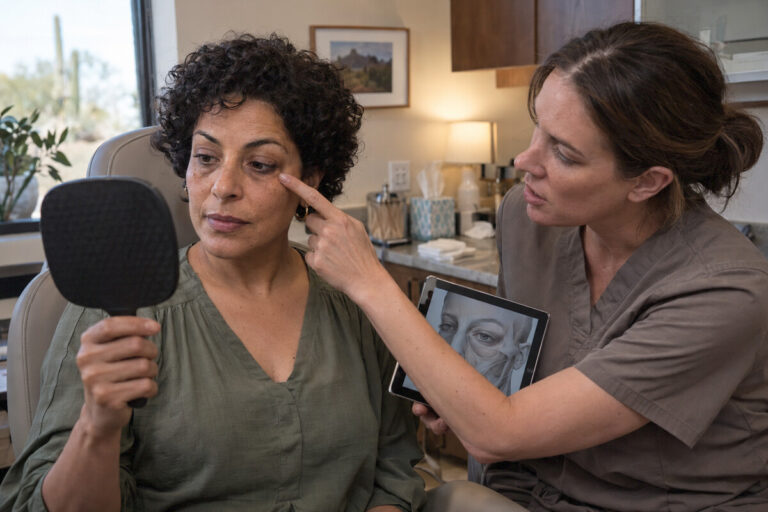
The same muscle that makes crow’s feet also lifts the cheek and narrows the eye when you smile, so the goal is softer lines, not a still eye. If the outer eye is relaxed too much, a smile can look as though it stops at the mouth. Crow’s feet are safest to treat in small amounts, placed superficially and well away from the eye.
- Stay outside the bony rimInjections should sit at the outer corner, away from the lower lid and the eye itself, to protect lid support.
- Match the smileYour smile should be assessed several times, because some people’s crow’s feet fan upward and others run down toward the cheek.
- Leave the lower lid aloneFine lines directly under the eye are a different problem. I explain why in lines under your eyes.
- Start conservativelyFor a first treatment I would rather add a unit or two at a follow-up than take away a natural smile for three months.
Side effects in this area are usually mild. In the Botox crow’s feet trials, the most common was eyelid swelling in 1 percent of patients. Small bruises are possible, as with any injection.
What helps static lines and prevention
For fine lines that stay at rest, relaxing the muscle is the first step, and then the skin itself needs attention.
- SunglassesThe AAD recommends them for squint lines, and they protect the eye area from UV.
- Daily sunscreenBroad-spectrum, water-resistant, SPF 30 or higher, including the skin around the eyes.
- Medical-grade skincareAn eye-area routine chosen for thin, sensitive skin. See medical-grade skincare.
- Not smokingThe AAD says smoking greatly speeds up how quickly skin ages.
Treating moving lines before they become static is also prevention, because it reduces the daily folding. Our Botox timeline guide explains when results show and when to plan the next visit, and our guide to forehead lines treatment covers the area above.
What it costs at KORA
Crow’s feet are priced per unit, and the number of units is set for your smile at the consultation.
Botox
Crow’s feet$13.50 / unit
Dysport
Crow’s feet$4.50 / unit
Daxxify
Crow’s feet$8 / unit
Prices come from our current price list. Your plan and total are confirmed at a complimentary consultation before anything begins.
Units are not interchangeable between products, so compare totals, not prices per unit. Learn more about Botox at our clinic on the Scottsdale and Paradise Valley border.
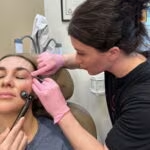 BotoxBotox in Scottsdale at KORA Aesthetics — $13.50 per unit, injected by a board-certified nurse practitioner and national clinical trainer. Forehead lines, frown lines, crow's feet, bunny lines, dimpled chin, masseter slimming, neck bands, hyperhidrosis and chronic migraine. See Botox cost per area, how long it lasts, and what to expect at each stage.See treatment, prices and results
Frequently asked questions
What is the most effective treatment for crow's feet?
For lines that show when you smile, a neuromodulator such as Botox is the most direct treatment, and Botox Cosmetic and Xeomin are FDA-approved for this area. Lines that stay at rest also benefit from sun protection and skin treatments.
How many units of Botox for crow's feet?
The FDA-labeled dose is 24 units, 12 per side in three injection points. Your plan may use fewer or more, and it is set at the consultation.
Will Botox for crow's feet change my smile?
It should not when it is dosed conservatively and placed away from the cheek. Too much in this area can make a smile look as if it stops at the mouth, which is why starting light makes sense.
Is Dysport approved for crow's feet?
No. Dysport and Daxxify are FDA-approved for frown lines; their use around the eyes is off-label. Botox Cosmetic and Xeomin are approved for crow's feet.
Do sunglasses help prevent crow's feet?
Yes. The American Academy of Dermatology says sunglasses can help reduce lines caused by squinting, and they protect the thin skin around the eyes from UV.
What are the side effects of Botox for crow's feet?
Usually mild. In the Botox trials, eyelid swelling affected 1 percent of patients, and small bruises are possible.
How much does Botox for crow's feet cost in Scottsdale?
Botox for crow's feet at KORA Aesthetics: $13.50 / unit. Your total depends on the units in your plan, confirmed at a complimentary consultation.
Sources
- Allergan (AbbVie). BOTOX Cosmetic (onabotulinumtoxinA) prescribing information, revised 10/2024. AbbVie, 2024
- Merz North America. XEOMIN (incobotulinumtoxinA) prescribing information, revised 2/2026. U.S. Food and Drug Administration, 2026
- Ipsen Biopharmaceuticals. DYSPORT (abobotulinumtoxinA) prescribing information, revised 1/2023. U.S. Food and Drug Administration, 2023
- Revance Therapeutics. DAXXIFY (daxibotulinumtoxinA-lanm) prescribing information, revised 11/2023. Drugs.com, 2023
- American Academy of Dermatology. 11 ways to reduce premature skin aging. AAD, accessed 2026
Katie Manhardt
Board-certified family nurse practitioner and founder of KORA Aesthetics in Scottsdale. Katie is a national clinical trainer for Galderma and Prollenium — selected to teach injection technique and facial anatomy to other medical professionals. Every treatment at KORA is performed by Katie or by one…