5 min readUpdated
Sculptra or Filler: Which Do You Need?
Sculptra vs filler compared on speed, how long each lasts, reversibility and what each is approved for, so you can see which one fits your face.

If you only read one thing
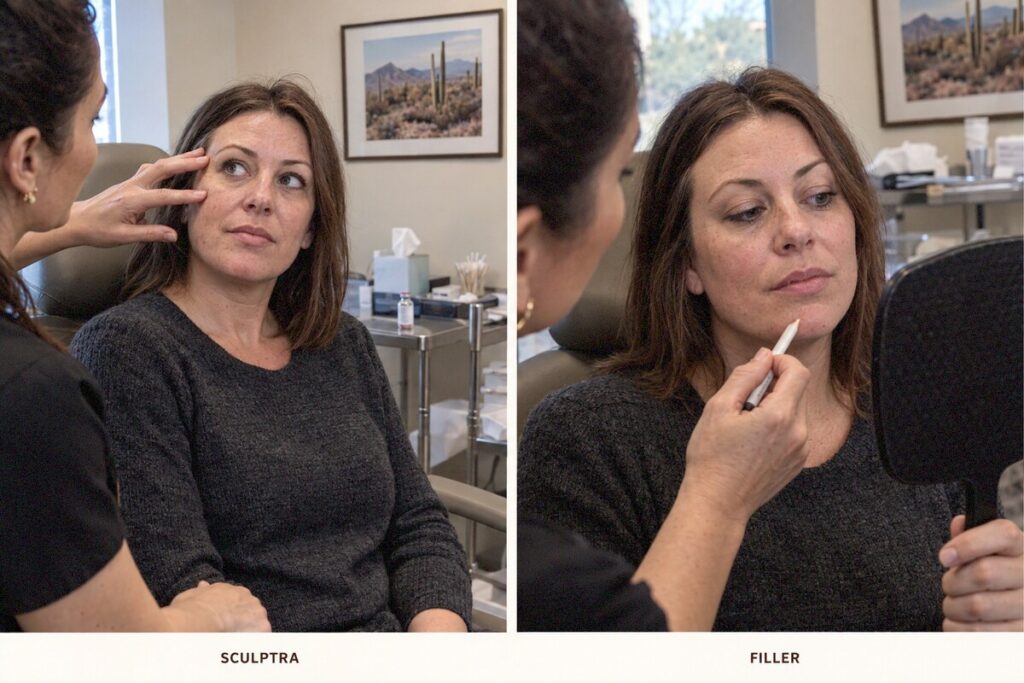
Choose hyaluronic acid filler if you want a visible change in one area, such as lips, chin or a fold, on the day, with the option to dissolve it. Choose Sculptra if you have broad, gradual volume loss and are happy to wait a few months for your own collagen to build, over about three sessions. The FDA puts hyaluronic acid filler at about 6 to 12 months and Sculptra at up to two years. The two are often combined.
- Filler: visible the same day, suits a defined area, and can be dissolved with hyaluronidase.
- Sculptra: builds collagen over months, suits broad volume loss, and cannot be dissolved.
- FDA figures: about 6 to 12 months for hyaluronic acid filler, up to two years for poly-L-lactic acid.
- Sculptra usually takes an average of three sessions at least three weeks apart; filler is often one visit.
- At KORA: Sculptra Starting at $800+; cheek filler Starting at $750+.
On this page 8 sections
Sculptra and filler are easy to confuse: both restore volume, but filler suits a single spot you want changed now, while Sculptra suits the slow, all-over thinning it was designed for. In this guide I compare Sculptra vs filler on speed, how long each lasts, whether it can be reversed and what each is approved for, so you can tell which one fits what you see in the mirror.
The quick decision
Filler is the better fit for a specific spot you want changed soon; Sculptra is the better fit for broad, gradual volume loss you are happy to treat over a few months.
Filler tends to suit you if
- You want to see the change nowHyaluronic acid filler gives visible volume on the day, and it settles over about two weeks.
- The concern is one defined areaLips, a chin that needs projection, a jawline, a deep fold or a single hollow.
- You want the option to undo itHyaluronic acid filler can be dissolved with an enzyme if needed.
Sculptra tends to suit you if
- Volume loss is spread across the faceFlatter cheeks, hollowing temples and thinner skin rather than a single line.
- You prefer a slow changeThe result builds over months, so friends tend to notice that you look well rather than that you had something done.
- Longevity matters more than speedThe FDA says the effects of poly-L-lactic acid may last up to two years.
How Sculptra and filler work differently
Filler adds volume directly, while Sculptra prompts your skin to make more of its own collagen. Most fillers are hyaluronic acid, a gel that holds water and sits where it is placed, so the shape you see on the day is close to the shape you keep. Sculptra is poly-L-lactic acid. Its early fullness is mostly water and fades within days; the lasting result comes from collagen that forms over the following months. Our What Is Sculptra? guide explains the mechanism in full.
| Hyaluronic acid filler | Sculptra | |
|---|---|---|
| How it works | Gel adds volume where placed | Stimulates your own collagen |
| When you see it | Same day; settles over about 2 weeks | Builds over months |
| Sessions | Usually one, sometimes a top-up | Average of three, at least three weeks apart |
| How long it lasts (FDA) | About 6 to 12 months | Up to 2 years |
| Can it be dissolved? | Yes, with hyaluronidase | No |
| FDA-approved for | Varies by product: lips, cheeks, chin, smile lines and other folds, back of the hands | Smile lines and facial wrinkles, cheek wrinkles |
| Not used in | Depends on the product | Lips; not studied around the eyes |
The durations above come from the FDA’s overview of approved dermal fillers. Real-world longevity varies by product, area and person.
Speed of results
If you have an event in the next couple of months, that timeline alone usually settles the decision in favor of filler. Galderma states that Sculptra results build over an average of three treatments spaced at least three weeks apart, and we judge the full result about three months after the last session. Our Sculptra timeline lays this out week by week.
Reversibility is a real factor
Hyaluronic acid filler can be broken down with hyaluronidase; Sculptra cannot be dissolved. Hyaluronidase is an FDA-approved enzyme, and using it to dissolve filler is a well-established off-label use. There is no equivalent for Sculptra, so if you are new to injectables or unsure what you want, my advice is to start with something reversible. Sculptra’s main specific risk, delayed lumps under the skin, is covered in our Sculptra safety guide.
Often the answer is both
For many faces the most natural result uses Sculptra for broad support and a small amount of filler for definition. Sculptra rebuilds the foundation across the cheeks and temples over a few months. Once that has settled, a little hyaluronic acid filler can sharpen a jawline, support the chin or refine one spot that still needs it. Starting with Sculptra can mean less filler is needed overall.
What Sculptra and filler cost at KORA
Filler is priced by area and Sculptra by the vial, so the two are not directly comparable session for session.
Sculptra for the face
Per vialStarting at $800+
Dermal filler
CheeksStarting at $750+
Smile linesStarting at $650+
Consultation
Either or bothComplimentary
Prices come from our current price list. Your plan and total are confirmed at a complimentary consultation before anything begins.
Not sure which one you need?
You do not have to decide before you come in. Learn more about Sculptra and dermal fillers at KORA, or read how to get rid of smile lines if a fold is your main concern. We offer both at our clinic on the Scottsdale and Paradise Valley border.
 SculptraSculptra in Scottsdale at KORA Aesthetics — from $800 a vial, or $3,500 for the body course, injected by a national clinical trainer for Galderma, the company that makes it. It stimulates your own collagen rather than filling, so the result builds over months. See how many vials you need and why it is not a same-day change.See treatment, prices and results
Frequently asked questions
Is Sculptra the same as filler?
No. Hyaluronic acid filler adds volume you see straight away and can be dissolved. Sculptra stimulates your own collagen over months and cannot be dissolved, although the FDA groups both as dermal fillers.
Which lasts longer, Sculptra or filler?
Sculptra, generally. The FDA says poly-L-lactic acid effects may last up to two years, and hyaluronic acid fillers about 6 to 12 months, depending on the product and area.
Which is better for hollow cheeks?
Both can work. Filler gives a defined lift on the day; Sculptra rebuilds broader volume gradually. Sculptra is FDA-approved for cheek wrinkles, and several hyaluronic acid fillers are approved for cheek augmentation.
Can I combine Sculptra and filler?
Yes. A common plan is Sculptra for broad support first, then a small amount of filler for definition once the collagen has built.
Can Sculptra be used in the lips?
No. The FDA label says it should not be injected into the red part of the lips. Lip filler is the right tool there.
How much do Sculptra and filler cost in Scottsdale?
At KORA Aesthetics, Sculptra for the face is Starting at $800+ and cheek filler is Starting at $750+. Your total is confirmed at a complimentary consultation.
Sources
- U.S. Food and Drug Administration. Dermal fillers approved by the Center for Devices and Radiological Health. FDA, 2020
- U.S. Food and Drug Administration. Dermal fillers (soft tissue fillers). FDA, 2023
- U.S. Food and Drug Administration. Sculptra Aesthetic (injectable poly-L-lactic acid) labeling, PMA P030050/S039. accessdata.fda.gov, 2023
- Galderma. Galderma receives FDA approval for new Sculptra label, offering more options to aesthetic partners. Galderma, December 2021
- Galderma. Galderma receives FDA approval for Sculptra for cheek wrinkles. Press release via BioSpace, April 2023
Katie Manhardt
Board-certified family nurse practitioner and founder of KORA Aesthetics in Scottsdale. Katie is a national clinical trainer for Galderma and Prollenium — selected to teach injection technique and facial anatomy to other medical professionals. Every treatment at KORA is performed by Katie or by one…