7 min readUpdated
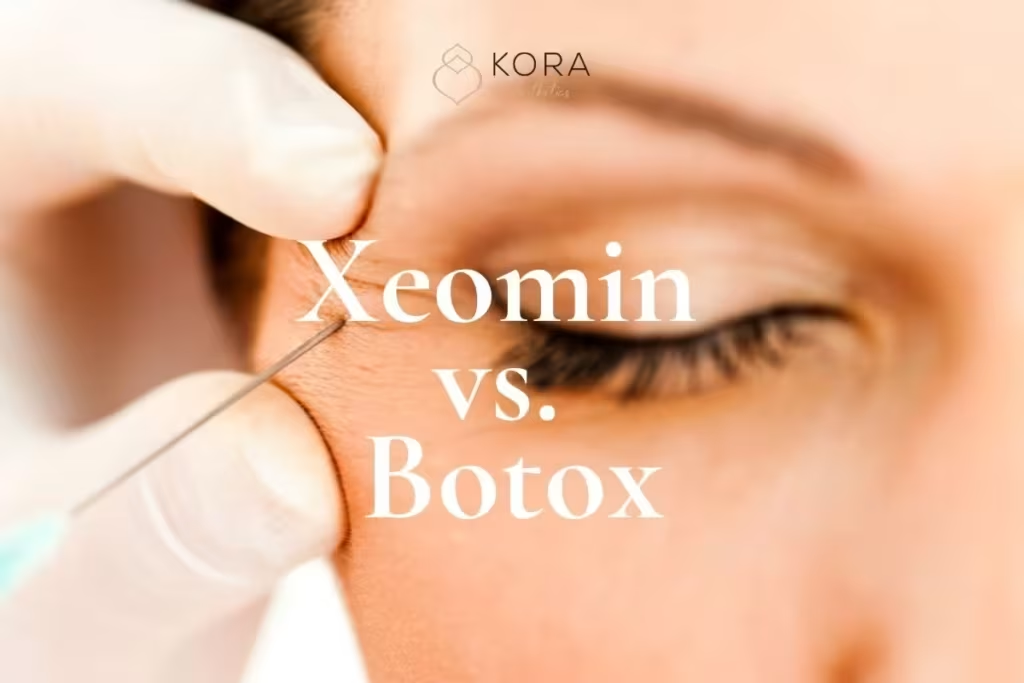
Xeomin vs Botox: What the Research Shows and How to Choose
Xeomin and Botox are both botulinum toxin type A with the same FDA-approved upper-face areas. What head-to-head trials found, the antibody question, and how to choose.

If you only read one thing
Xeomin and Botox are both botulinum toxin type A, both FDA-approved for frown lines, forehead lines and crow's feet, and in head-to-head trials at the same 20-unit dose they worked equally well. The main difference is that Xeomin contains no accessory proteins, which may lower antibody risk in theory, although antibodies are rare with either at cosmetic doses. For most people, past response and the treatment plan matter more than the brand.
- Both are FDA-approved for frown lines, forehead lines and crow's feet; Botox Cosmetic is also approved for platysma bands.
- A Merz-funded trial of 250 women found 20 units of each equally effective at one month and similar through four months.
- Xeomin has no accessory proteins. In 13 Xeomin trials, 0.5 percent of 4,435 patients developed antibodies; the Botox crow's feet trials found no neutralizing antibodies in 916 patients.
- Units are not interchangeable between brands, even when the labeled numbers match.
- Botox at KORA: $13.50 / unit. The consultation is complimentary.
On this page 7 sections
Xeomin vs Botox is a common question, often from people who have heard that one is “purer” or lasts longer. In this guide I explain what the FDA labels say about each product, what head-to-head studies found, where the “naked toxin” and antibody claims stand, and what that means when you are choosing. At KORA we offer Botox, Dysport and Daxxify; if you want Xeomin specifically, ask whether Xeomin is available when you book.
What Xeomin and Botox have in common
Xeomin (incobotulinumtoxinA) and Botox Cosmetic (onabotulinumtoxinA) are both botulinum toxin type A, and both work the same way: they block the nerve signal that tells a muscle to contract, so the skin above it stops creasing. Since July 2024 they also share the same FDA-approved cosmetic areas for the upper face. Merz announced that month that Xeomin was approved for forehead lines, frown lines and crow’s feet together, based on two phase 3 trials in 730 adults. Botox Cosmetic is approved for the same three areas and, since its label update in October 2024, for platysma bands in the neck as well.
The labeled doses are the same on paper: 20 units for frown lines, 20 units for the forehead given together with the frown lines, and 24 units for crow’s feet. That does not make the units the same thing. Xeomin’s label states that its units “cannot be compared to or converted into Units of any other botulinum toxin products,” and the Botox Cosmetic label says it “is not equivalent to other preparations of botulinum toxin products.” Each company measures potency with its own test. In practice, as the studies below show, Xeomin and Botox are usually dosed at about the same number of units.
| Xeomin | Botox Cosmetic | |
|---|---|---|
| FDA-approved cosmetic areas | Frown lines, forehead lines, crow’s feet | Frown lines, forehead lines, crow’s feet, platysma bands |
| Labeled dose for frown lines | 20 units | 20 units |
| Accessory proteins | None; the label describes the toxin “without accessory proteins” | Present; the label describes a complex of the neurotoxin and “several accessory proteins” |
| Storage before mixing | At or below 25 C; refrigeration not required | Refrigerated, 2 to 8 C |
| Retreatment interval on the label | No more often than every 3 months | Not studied more often than every 3 months |
What head-to-head studies found
When Xeomin and Botox have been compared directly at the same dose, they have performed about the same. A randomized trial led by Kane and colleagues and published in Dermatologic Surgery in 2015, randomized 250 women aged 18 to 50 with moderate to severe frown lines to 20 units of either product. Neither the patients nor the assessors knew which one was used. The two were equally effective at one month, the main endpoint, and had similar results and side effects through four months. The study was funded by Merz, the maker of Xeomin, which is worth knowing; its result was equivalence, not superiority.
A 2012 meta-analysis in the Journal of Drugs in Dermatology by Jandhyala pooled 11 studies that compared the two products. At 24 units, Xeomin had a 94 percent statistical likelihood of being slightly more effective, but the author judged the difference not clinically meaningful and concluded the two should be treated as equally potent unless better evidence appears. In practical terms, unit for unit, you can expect a similar effect.
You may see different success rates on the two labels, for example 67 and 58 percent for Xeomin on forehead lines and 61 and 46 percent for Botox. Those numbers come from separate trials with different patients and different scoring rules, so they cannot be compared with each other. Only a head-to-head trial answers which works better, and those trials point to a tie.
The “naked toxin” and the antibody question
The real manufacturing difference is that Xeomin is purified down to the toxin alone, while Botox keeps accessory proteins around it. The theory is that fewer foreign proteins give the immune system less to react to, so the body is less likely to make neutralizing antibodies that stop the toxin working.
What the research shows is that this is uncommon with either product at cosmetic doses. A 2024 literature review in the journal Life by Lee and colleagues reported that across 13 Xeomin facial-line trials in 4,435 patients, 0.5 percent developed antibodies, most of them non-neutralizing, at a rate similar to placebo. The Botox Cosmetic label reports that in its crow’s feet trials, 1.5 percent of 916 patients developed binding antibodies and none developed neutralizing antibodies. The same review found that the factors linked to antibodies are mostly high cumulative doses, large doses per session and injections given close together, and most of that evidence comes from medical uses such as spasticity, where doses are far higher than for wrinkles.
Where Xeomin can make sense: if a patient has stopped responding to a toxin after previously good results, switching to a product without accessory proteins is a reasonable step, and the review cites medical studies supporting it. For a first-time or occasional cosmetic patient, there is no strong evidence that the choice changes the risk in a way you would notice.
Onset, duration and how they feel
Onset and duration are similar enough that your own muscles matter more than the brand. The Botox Cosmetic label says the effect usually begins one to two days after injection, builds through the first week, and lasts about three to four months for frown lines. In the 2015 head-to-head trial, results tracked closely for both products through four months. How long it lasts for you depends more on your muscles and your dose than on the brand, which I explain in our Botox timeline guide.
The appointment itself feels the same: a few small injections, a short pinch with each, and no recovery time beyond the usual aftercare. Storage is a clinic matter rather than a patient one. Xeomin can sit at room temperature before it is mixed, while Botox must be refrigerated; once either is prepared, it is handled the same way.
How to choose between Xeomin, Botox and the alternatives
For most people, the injector’s plan for your muscles matters more than which of these two products is in the syringe. These are the questions I would bring to a consultation:
- “Which product have I had before, and how did it work?”Bring the name and number of units from past treatments if you have them. A good past response is a reason to stay with it.
- “Is the area I want treated FDA-approved for this product?”Frown lines, forehead lines and crow’s feet are approved for both. Other areas, such as the jaw or the lip, are off-label for both.
- “How many units, and how often?”Units are not interchangeable between brands, so compare plans, not unit counts. Both labels set three months as the minimum interval that has been studied.
- “Would a longer-lasting option suit me better?”Daxxify is FDA-approved for frown lines at 40 units, and its label trials followed patients for at least 24 weeks. Ask whether a longer-acting product suits your schedule.
If you are comparing Botox with Dysport as well, my Dysport vs Botox guide covers how the unit conversion works and what head-to-head trials found.
What it costs at KORA
Because units differ between brands, a price per unit only means something next to the number of units your plan needs.
Botox
Per unit$13.50 / unit
Daxxify
Per unit$8 / unit
Consultation
Assessment and planComplimentary
Prices come from our current price list. Your plan and total are confirmed at a complimentary consultation before anything begins.
Read more about Botox and Daxxify at our clinic on the Scottsdale and Paradise Valley border, or see how many units of Botox common areas need.
 BotoxBotox in Scottsdale at KORA Aesthetics — $13.50 per unit, injected by a board-certified nurse practitioner and national clinical trainer. Forehead lines, frown lines, crow's feet, bunny lines, dimpled chin, masseter slimming, neck bands, hyperhidrosis and chronic migraine. See Botox cost per area, how long it lasts, and what to expect at each stage.See treatment, prices and results
Frequently asked questions
Is Xeomin better than Botox?
Neither has been shown to be better. In a randomized trial of 250 women, 20 units of each worked equally well at one month and similarly through four months.
Does Xeomin last longer than Botox?
Head-to-head research has not shown a meaningful difference. The Botox Cosmetic label gives about three to four months for frown lines, and individual factors such as muscle strength affect duration more than the brand.
What does "naked toxin" mean?
It means Xeomin is purified to the toxin alone, without the accessory proteins that surround the toxin in Botox. Its FDA label describes the active neurotoxin "without accessory proteins."
Can you become resistant to Botox?
It is rare at cosmetic doses. The Botox Cosmetic crow's feet trials found no neutralizing antibodies in 916 patients, and antibody risk is linked mainly to high doses and injections given close together.
Is 20 units of Xeomin the same as 20 units of Botox?
The labels say units cannot be converted between brands, because each company measures potency differently. In practice, studies have used the two at about the same number of units with similar results.
Is Xeomin FDA-approved for forehead lines and crow's feet?
Yes. In July 2024 the FDA approved Xeomin for forehead lines, frown lines and crow's feet treated together, at up to 64 units in total.
How much does Botox cost in Scottsdale?
Botox at KORA Aesthetics: $13.50 / unit. Your total depends on the areas and units in your plan, which we confirm at a complimentary consultation.
Sources
- Merz North America. XEOMIN (incobotulinumtoxinA) prescribing information, revised 2/2026. U.S. Food and Drug Administration, 2026
- Allergan (AbbVie). BOTOX Cosmetic (onabotulinumtoxinA) prescribing information, revised 10/2024. AbbVie, 2024
- Merz Aesthetics. FDA approval of Xeomin for the simultaneous treatment of upper facial lines. Business Wire, July 2024
- Kane MA, Gold MH, Coleman WP, et al. Randomized, double-blind trial of incobotulinumtoxinA vs onabotulinumtoxinA for glabellar lines. Dermatologic Surgery, 2015 (summary in The Aesthetic Guide)
- Jandhyala R. Relative potency of incobotulinumtoxinA vs onabotulinumtoxinA: a meta-analysis of key evidence. Journal of Drugs in Dermatology, 2012
- Lee KWA, Chan LKW, Lee AWK, et al. Immunogenicity of botulinum toxin type A in different clinical and cosmetic treatment, a literature review. Life, 2024
Katie Manhardt
Board-certified family nurse practitioner and founder of KORA Aesthetics in Scottsdale. Katie is a national clinical trainer for Galderma and Prollenium — selected to teach injection technique and facial anatomy to other medical professionals. Every treatment at KORA is performed by Katie or by one…