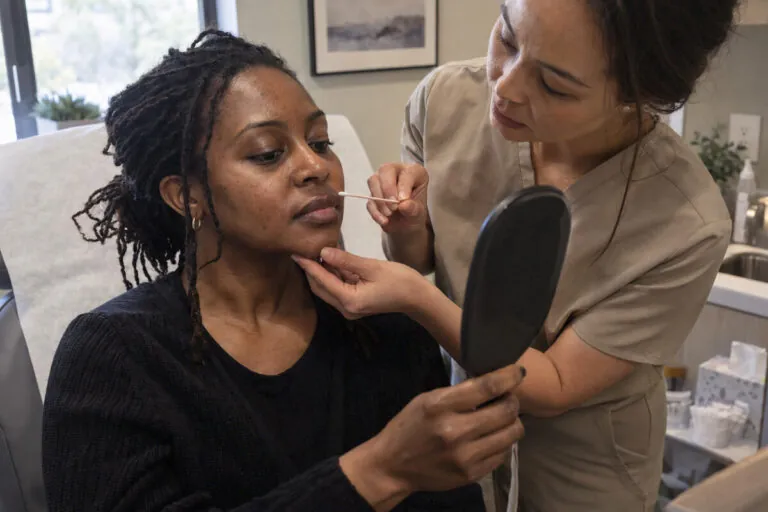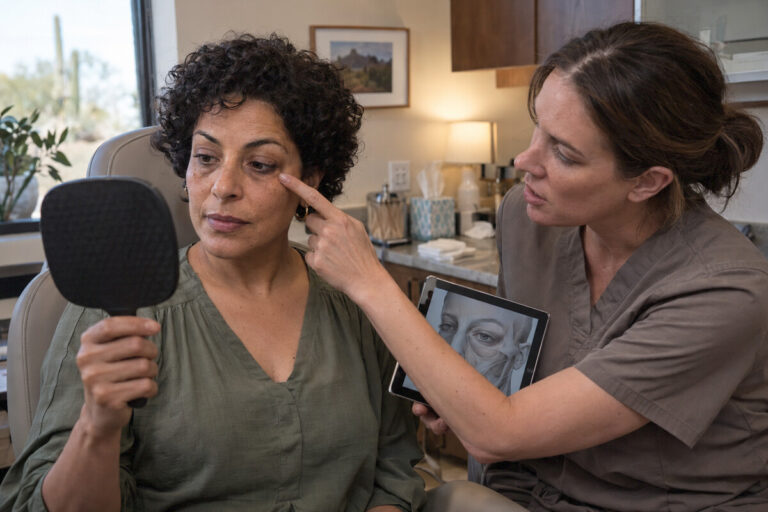

The first 24 hours, in short
Do this
- Stay upright for the first 4 hours
- Keep your face relaxed and still
- Go about a normal, calm day
- Wait for it to take effect over 3 to 14 days
Skip this
- Touching, rubbing or massaging the area, 4 hours
- Lying flat or face-down, 4 hours
- Exercise, alcohol and makeup, 24 hours
- Facials, peels or microneedling, 2 weeks
The restrictions that actually matter, and until when
Stay upright. Do not touch, rub or massage the area.
No exercise, no alcohol, no lip or brow makeup.
Normal skincare and activity can resume.
No facials, peels or microneedling over the treated area.
Why the rules exist
Every instruction below traces back to one fact about how Botox actually works.
Botox is a purified protein that blocks the nerve signal telling a muscle to contract. It does not do this instantly. After injection, it needs time to bind to the nerve endings in the muscle it was placed in – typically starting within 2 to 3 days, with visible effect building over the first week and full results by around two weeks.
Until it has bound, there is a narrow window where firm pressure or unusual movement in the treated area could, in theory, encourage the product to spread beyond where it was placed. This is the entire reason behind avoiding lying flat, rubbing the area and strenuous exercise in the first few hours: not because the product is fragile, but because it has not yet settled into place.
The rules are not about protecting Botox from being undone. They are about keeping it exactly where your injector put it.
That is also why the list of restrictions is shorter and the windows are tighter than aftercare for a dermal filler. Botox is not a physical volume sitting in tissue; it is a signal-blocker that needs to reach the right nerve endings and stay there for a few hours before its position is essentially fixed.
The first 4 hours
Stay upright
Avoid lying flat, bending forward for long periods, or sleeping for the first 4 hours. Gravity working against a treated muscle in this early window is the theoretical mechanism behind product migration, and it is the easiest rule to follow: just stay sitting or standing.
Do not touch the area
No rubbing, pressing, or resting your face in your hands. If your injector gave you specific facial exercises to do in the first hour (some practices recommend gently activating the treated muscle to encourage even uptake), follow those instructions exactly and do nothing else. If you were not given specific exercises, the safest approach is simply to leave the area alone.
Skip the workout, for now
Hold off on anything strenuous for the rest of the day. More on timing below.
The first 24 hours
Once the first 4 hours have passed, the most sensitive window is over. The next set of restrictions is about reducing swelling, bruising and irritation rather than preventing migration.
Makeup
Wait a few hours before applying makeup over the injection sites, and use clean hands or a fresh applicator. The injection points are small and close within hours, but freshly pierced skin is still worth treating carefully.
Ice, if you want it
A little swelling or redness at the injection sites is normal and usually gone within hours. A cold compress held gently nearby, not pressed onto the area, can help with comfort.
Exercise
Avoid strenuous exercise for 24 hours. Raised blood pressure and heart rate increase blood flow to the face, which can worsen bruising and, in the earliest hours, is part of the same migration caution covered above.
Walking is fine. Hot yoga, running, weights and anything that leaves you red in the face should wait until the next day.
Alcohol
Skip alcohol for 24 hours, and ideally the same the evening before treatment. Alcohol thins the blood slightly and dilates blood vessels, which makes bruising at the injection sites more likely. It has no effect on how well Botox works, but bruising is the single most common thing patients wish they had avoided, and this is the easiest way to reduce it.
Heat, sun and tanning
Avoid saunas, steam rooms, hot tubs and prolonged direct sun for 24 hours, for the same reason as exercise: heat increases blood flow to the face. In Arizona this is worth taking seriously in summer, when even a short walk can mean real heat exposure.
Sun exposure itself does not affect how Botox works or how long it lasts, but it does affect how your skin looks while you wait for results, and it is a factor in how quickly new lines form afterward.
Massage and facial pressure
General body massage is fine as long as your face, neck and any other treated area are avoided. A facial massage, gua sha, jade rolling or any firm pressure over the treated muscles should wait at least 24 hours, and some injectors prefer a full week if the treated area is close to the eyes or brows.
This is different advice from dermal filler, where a specific massage technique is sometimes used deliberately to shape the result. With Botox, the goal is the opposite: leave the product exactly where it was placed, so unless your injector has specifically told you to massage an area, do not.
Other facial treatments
Wait at least 2 weeks before microneedling, chemical peels, facials with extractions, or any other treatment that involves pressure, heat or manipulation of the treated muscles.
Two reasons. First, the same migration caution applies for longer than 24 hours when the treatment itself involves direct pressure on the face rather than just daily activity. Second, once Botox has fully taken effect at two weeks, it is much easier for you and your provider to see the real result and plan any additional treatment around it, rather than layering a peel or microneedling session on top of a face that is still settling.
If you have a chemical peel or microneedling already booked, it is usually easier to move that appointment than to move your Botox.
Medications
If you are on a prescribed medication, do not stop or delay it around a Botox appointment without talking to the prescribing doctor first. Two categories are worth knowing about specifically.
Blood thinners and regular NSAID use (ibuprofen, aspirin) increase the chance of bruising at the injection sites, the same as with any injectable. If a doctor has you on one of these, stay on it; the trade-off is a slightly higher chance of a bruise, not a safety issue.
Certain antibiotics, specifically the aminoglycoside class, can theoretically enhance the effect of Botox when taken around the same time. This is worth flagging to your injector rather than managing on your own.
Why you should not judge it early
Botox takes 3 to 7 days to start working and up to two weeks to reach its full effect. A significant number of “it didn’t work” concerns are really “it hasn’t finished working yet” concerns, raised at day 4 or 5.
Give it the full two weeks before deciding anything looks wrong, uneven, or insufficient. Early asymmetry between the two sides of the face is common and usually resolves on its own as the product finishes taking effect.
If, after two full weeks, something genuinely looks off, that is exactly the right time to book a review. Most practices, including ours, build a two-week check-in into the treatment for this reason.
Contact your injector, or seek care, if you notice
- A drooping eyelid or brow that appears in the days after treatment. This is called ptosis. It is uncommon, temporary, and treatable with eye drops your injector can prescribe, but it should be assessed rather than waited out.
- Difficulty swallowing, speaking or breathing in the days after treatment. This is rare but is listed as a serious warning sign by the FDA for all botulinum toxin products, because it can indicate the effect has spread beyond the treated area. Seek medical care right away.
- Vision changes, including double vision or trouble focusing.
- Signs of an allergic reaction: hives, itching, wheezing, or swelling of the face or throat.
- Asymmetry or a result that still looks wrong after two full weeks – not urgent, but worth a review appointment.
The first four are uncommon, and the reason to name them plainly is so you recognize them quickly rather than second-guess yourself if they happen. No competent injector will mind a call that turns out to be nothing.
Myths worth dropping
- “You have to keep frowning or raising your eyebrows for it to set properly.”
- Beyond any specific exercise your injector asks for in the first hour, repeated movement does not speed up or improve the result. It takes the time it takes.
- “If you bend over or exercise too soon, the Botox will completely fail.”
- The actual risk is subtle migration to a nearby muscle, not a wasted treatment. It is a reason for caution in the first day, not a reason to panic if you forgot and bent down to tie your shoes.
- “Drinking water flushes it out faster.”
- No. Hydration does not affect how Botox is metabolized or how long it lasts.
- “A slightly uneven result on day 3 means it went wrong.”
- Botox has not finished working at day 3. Wait for the two-week mark before judging symmetry.
- “You can never work out again in the area.”
- The 24-hour window is it. After that, normal exercise has no effect on Botox.
Questions people ask
How long after Botox can I exercise?
Wait 24 hours before anything strenuous. Walking is fine right away.
Can I lie down after Botox?
Avoid lying flat or face-down for the first 4 hours. After that, normal sleep positions are fine.
Can I get a massage after Botox?
Body massage is fine if your face and neck are avoided. Facial massage, gua sha or jade rolling over the treated area should wait at least 24 hours, longer if the treated area is near the eyes or brows.
Can I wear makeup after Botox?
Wait a few hours, then use clean hands or a fresh applicator.
Can I drink alcohol after Botox?
Wait 24 hours. Alcohol does not affect how well Botox works but does increase the chance of bruising at the injection sites.
When can I get a facial or chemical peel after Botox?
Wait at least 2 weeks.
Why can’t I exercise or lie down right after Botox?
Botox needs a few hours to bind to the nerve endings in the treated muscle. Pressure, heat or unusual movement in that window is the theoretical mechanism for the product spreading beyond where it was placed.
How long does it take to see results?
3 to 7 days to start, up to 2 weeks for the full effect.
Is a drooping eyelid after Botox permanent?
No. Ptosis is uncommon and temporary, typically resolving as the treatment wears off, and it can be managed with prescription eye drops in the meantime. Contact your injector if it happens.
Can I take ibuprofen or aspirin after Botox?
If prescribed, stay on it. Both increase the chance of bruising at the injection sites but do not affect how well Botox works.
Can I get Botox while on antibiotics?
Usually, but the aminoglycoside class can interact with how Botox works. Worth flagging to your injector before your appointment.
My results look uneven a few days in. Is that normal?
Very often, yes. Botox has not finished taking effect until around two weeks. Give it the full window before judging symmetry, then book a review if something still looks off.
The short version
Stay upright and leave the area alone for 4 hours. Skip exercise, alcohol and makeup for 24. Skip facials, peels and microneedling for 2 weeks. Give it the full two weeks before you judge the result. And if you notice a drooping eyelid, trouble swallowing or breathing, or vision changes, call your injector or seek care right away rather than waiting to see.
Everything else is a normal day.
Considering Botox in Scottsdale?
A nurse practitioner-led practice in Scottsdale, Arizona. Every treatment is performed by Katie or by one of the practice’s nurse practitioners – never delegated to a technician.