7 min readUpdated
VI Peel for Acne and Acne Scars: What It Can and Can’t Do
What a VI Peel can do for active acne and acne marks, why depressed scars need a different treatment, and how skin tone affects peel safety.

If you only read one thing
A VI Peel can help mild to moderate acne and fades the flat brown marks that breakouts leave behind. Research shows common chemical peels work similarly well for mild to moderate acne. Peels do much less for depressed scars: in a 2022 trial, microneedling improved scars in 73% of patients versus 33% for a glycolic peel. Darker skin types carry a higher risk of post-peel dark patches, so preparation matters. Most people need a series of peels.
- A 2018 review of 12 trials found common chemical peels similarly effective and well tolerated for mild-to-moderate acne.
- VI Peel Precision Plus is designed for pigment, including the dark marks acne leaves, according to the manufacturer.
- For depressed scars, microneedling improved 73% of patients vs 33% for a glycolic peel in a 2022 trial.
- Darker skin types have a higher risk of post-peel hyperpigmentation; sunscreen and preparation beforehand lower it.
- The manufacturer recommends 3 to 6 peels, 4 to 6 weeks apart.
- VI Peel Precision Plus at KORA: $349.
On this page 7 sections
A VI Peel can help with breakouts and with the dark marks acne leaves behind, but it does much less for scars that sit below the surface. In this guide on the VI Peel for acne and acne scars, I explain what the peel is, what published studies on chemical peels for acne show, which kinds of scars respond, and how skin tone changes the plan.
What a VI Peel is
The VI Peel is a medium-depth chemical peel. According to the manufacturer, its formulas reach through the top layer of skin to the upper dermis, and the range includes several versions for different concerns. The manufacturer lists an allergy to aspirin, hydroquinone or phenol as a reason not to have the peel.
At KORA we offer VI Peel Precision Plus. The manufacturer’s product information describes it as a formula that targets pigmentation, including sun damage, melasma and post-inflammatory hyperpigmentation, which is the flat brown mark left after a breakout heals. That makes it a good fit for acne marks, and one part of a plan for active acne.
What the research shows for active acne
Chemical peels do help mild to moderate acne, and no single type has been proven better than the others. The most useful summary is a 2018 systematic review in BMJ Open by Chen and colleagues, which pooled 12 randomized trials with 387 patients. The authors concluded that “commonly used chemical peels appear to be similarly effective for mild-to-moderate acne vulgaris and well tolerated.” In the only placebo-controlled trial they found, 92 percent of patients treated with a glycolic acid peel had good or excellent improvement, compared with 40 percent on placebo. Salicylic acid peels cut blackheads and whiteheads by 53.4 percent compared with 26.3 percent for Jessner’s solution, and a TCA peel performed about the same as salicylic acid.
The same review is careful about the limits: the trials were small, of low to moderate quality and used different peels and schedules, so the authors could not draw a firm conclusion about which peel is superior. A 2018 review by Castillo and Keri in Clinical, Cosmetic and Investigational Dermatology reaches a similar view and describes peels as one part of acne treatment. Nearly all of the studies used peels every two to three weeks for several sessions. I recommend using a peel alongside a daily acne skincare routine, and anyone with deep, painful or cystic acne also needs medical acne treatment from a dermatologist or their own clinician.
Acne marks vs acne scars: what a peel can and cannot do
The word “scar” covers two different things, and a peel helps one of them much more than the other.
| What you see | What it is | How much a peel helps | What else helps |
|---|---|---|---|
| Flat brown marks | Post-inflammatory pigment, not a true scar | Well; this is what Precision Plus targets | Daily sunscreen and skincare |
| Flat red or pink marks | Post-inflammatory redness, not a true scar | Somewhat; redness often fades with time | Sun protection and patience |
| Rolling scars (soft waves) | Bands under the skin pulling it down | A little, on surface texture | Microneedling |
| Boxcar scars (sharp edges) | Wider depressions with steep sides | A little | Microneedling; deep boxcar scars often need other techniques |
| Icepick scars (narrow, deep) | Deep, narrow tracts | Very little | Usually other techniques, such as punch excision or TCA CROSS |
For depressed scars, the evidence favors microneedling. In a 2022 randomized trial in the Journal of Clinical and Aesthetic Dermatology, Ishfaq and colleagues treated 60 patients with Fitzpatrick skin types IV to VI with either microneedling or a 35 percent glycolic acid peel, six sessions two weeks apart. Two weeks after the last session, 73.3 percent of the microneedling group had improved by more than one scar grade, compared with 33.3 percent of the peel group. That is why I recommend building a scar plan around microneedling and using peels for the color and surface tone. I explain the scar types in more detail in which acne scars respond to microneedling.
Skin tone and safety
The manufacturer states that VI Peel Precision Plus is safe for Fitzpatrick skin types I to VI, and the published research adds an important caveat: darker skin is more likely to develop dark patches after a peel. Castillo and Keri note that patients with skin types IV to VI “are at higher risk of postinflammatory/postpeel hyperpigmentation,” that TCA carries a greater risk of hyperpigmentation in darker skin, and that preparation should be emphasized. Their recommendations include sunscreen for two to three months before a peel and stopping tretinoin two to three weeks beforehand in darker skin, compared with 48 hours in lighter skin. Salicylic acid peels have a good record in darker skin: in a study they cite, post-peel darkening was rare and cleared within two weeks.
The manufacturer also lists reasons not to have a VI Peel, so tell us at your consultation if any of these apply:
- Pregnancy or breastfeedingThe manufacturer lists both as reasons not to have the peel, and there is not enough safety data, so tell us if you are pregnant, trying to conceive or nursing.
- Isotretinoin (Accutane) in the past six monthsSkin heals differently during and after isotretinoin, so the manufacturer advises waiting.
- Cold sores or a history of herpes simplexA peel can trigger an outbreak, so mention any history of cold sores; a peel should never go over an active sore.
- Allergy to aspirin, hydroquinone or phenolThese relate to ingredients in the peel.
- Eczema, autoimmune or liver disease, or recent chemotherapy or radiationThe manufacturer advises against the peel in these situations.
What to expect and how many peels you need
The peel itself takes about 30 minutes, and the visible part comes a few days later. The manufacturer says to expect peeling “on or around day three” and for about three to four days after that, and that nothing, including sunscreen, should go on the skin for the first four hours. For results, the manufacturer recommends a series of 3 to 6 peels spaced 4 to 6 weeks apart. Many people see a difference after the first peel, and the series builds on it. My full day-by-day guide is in chemical peel aftercare.
What it costs at KORA
VI Peel Precision Plus
Per peel$349
Microneedling
Per session$350
With PRF$450
Consultation
Skin assessmentComplimentary
Prices come from our current price list. Your plan and total are confirmed at a complimentary consultation before anything begins.
Learn more about the VI Peel and SkinPen PRF microneedling at our clinic on the Scottsdale and Paradise Valley border, or compare the two in chemical peel vs microneedling.
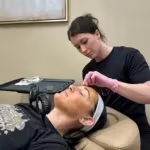 VI Chemical PeelVI Peel Precision Plus in Scottsdale at KORA Aesthetics — $349 a peel, applied by a nurse practitioner and formulated for melasma, sun damage and uneven tone. Safe on darker skin tones, and built for an Arizona UV load. See chemical peel cost, the day-by-day peeling timeline, and how many you need.See treatment, prices and results
Frequently asked questions
Does the VI Peel work for acne?
It can help mild to moderate acne as part of a skincare plan. A 2018 review of 12 trials found common chemical peels similarly effective for mild-to-moderate acne. Severe or cystic acne also needs medical treatment.
Can a VI Peel remove acne scars?
It fades flat brown marks well, but does little for depressed scars. Rolling, boxcar and icepick scars respond better to microneedling.
How many VI Peels do I need for acne marks?
The manufacturer recommends a series of 3 to 6 peels, spaced 4 to 6 weeks apart. Many patients see a change after the first peel.
Is the VI Peel safe for dark skin?
The manufacturer says it is safe for all skin types, but research shows darker skin has a higher risk of dark patches after a peel. Sunscreen for weeks beforehand and a careful plan reduce that risk.
When does the VI Peel start peeling?
Usually on or around day three, lasting about three to four days, according to the manufacturer.
Who should not get a VI Peel?
People who are pregnant or breastfeeding, have used isotretinoin in the past six months, have an active cold sore, or are allergic to aspirin, hydroquinone or phenol, among other reasons listed by the manufacturer.
How much is a VI Peel in Scottsdale?
VI Peel Precision Plus at KORA Aesthetics: $349. The consultation is complimentary.
Sources
- Chen X, Wang S, Yang M, Li L. Chemical peels for acne vulgaris: a systematic review of randomised controlled trials. BMJ Open, 2018;8(4):e019607
- Castillo DE, Keri JE. Chemical peels in the treatment of acne: patient selection and perspectives. Clinical, Cosmetic and Investigational Dermatology, 2018;11:365-372
- Ishfaq F, Shah R, Sharif S, Waqas N, Jamgochian M, Rao B. A Comparison of Microneedling versus Glycolic Acid Chemical Peel for the Treatment of Acne Scarring. Journal of Clinical and Aesthetic Dermatology, 2022;15(6):48-52
- VI Peel (manufacturer). VI Peel Precision Plus product information. VIPeel.com, accessed 2026
- VI Peel (manufacturer). Frequently Asked Questions. VIPeel.com, accessed 2026
Katie Manhardt
Board-certified family nurse practitioner and founder of KORA Aesthetics in Scottsdale. Katie is a national clinical trainer for Galderma and Prollenium — selected to teach injection technique and facial anatomy to other medical professionals. Every treatment at KORA is performed by Katie or by one…