6 min readUpdated
Botox for Chronic Migraine: Who Qualifies and What to Expect
Botox is FDA-approved for chronic migraine, 15 or more headache days a month. Who qualifies, the PREEMPT protocol, trial results and how long it takes to work.


If you only read one thing
Botox is FDA-approved to prevent headaches in adults with chronic migraine, meaning headaches on 15 or more days a month. The PREEMPT protocol uses 155 units at 31 sites across the head, neck and shoulders every 12 weeks. In the pooled trials, headache days fell by 8.4 a month vs 6.6 with placebo. It takes two to three cycles to judge, and it is not approved for episodic migraine. A headache specialist should diagnose and supervise it.
- Botox is FDA-approved for chronic migraine (15 or more headache days a month), not for episodic migraine.
- The PREEMPT protocol is 155 units at 31 sites in 7 head and neck muscle areas, repeated every 12 weeks.
- In the pooled PREEMPT trials of 1,384 adults, headache days fell by 8.4 a month with Botox vs 6.6 with placebo at 24 weeks.
- About half responded after the first cycle; more responded after the second and third, so judge it after two to three cycles.
- It is a medical treatment that should be planned by the physician who manages your headaches, separate from cosmetic Botox.
On this page 9 sections
Botox for chronic migraine is an FDA-approved medical treatment, and a common question is how it compares with cosmetic Botox. In this guide I explain who qualifies, how the PREEMPT injection protocol works, what the trials found, how long it takes to know whether it is working, and who should plan and supervise it.
Who Botox for migraine is for
Botox is FDA-approved to prevent headaches in adults with chronic migraine, and not for occasional or episodic migraine. The prescribing information defines chronic migraine as headaches on 15 or more days a month, each lasting four hours a day or longer, and states that safety and effectiveness have not been established for episodic migraine (14 or fewer headache days a month).
Headache specialists diagnose chronic migraine using the International Classification of Headache Disorders (ICHD-3): headache on at least 15 days a month for more than three months, with migraine features on at least 8 of those days. Frequent or severe headaches alone don’t meet that definition, and tension-type headaches are a different condition.
Where this treatment belongs: migraine Botox is prescribed and managed by the physician treating your headaches, usually a neurologist or headache specialist, alongside your other migraine care. If you also have cosmetic Botox, tell both providers so the timing can be coordinated. This guide is here to help you understand the treatment and ask good questions.
How it works
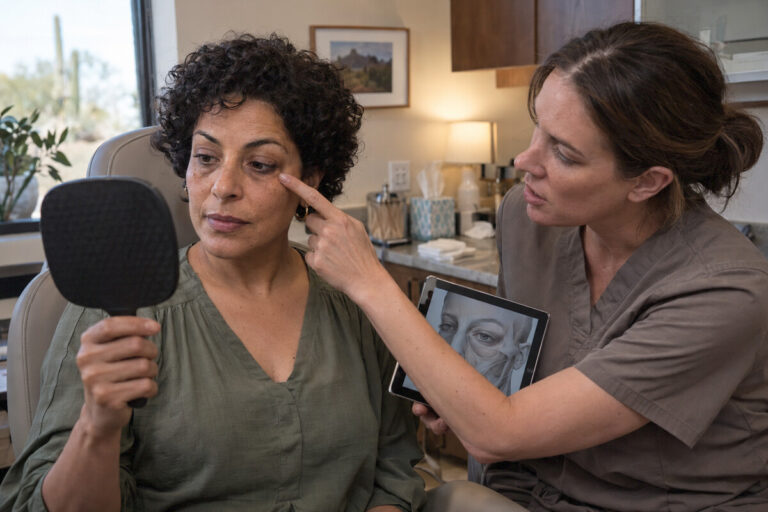
For migraine, Botox is thought to work on pain pathways, not on wrinkles. It is injected into muscles of the head and neck, where it is believed to reduce the release of pain-signaling chemicals from nerve endings and so make the pain pathways involved in migraine less easily activated. It is a preventive treatment: it is meant to reduce how many headache days you have, not to stop a migraine that has already started.
The PREEMPT protocol
The treatment follows a fixed injection pattern called the PREEMPT protocol, named after the trials that led to its approval. The label sets it out as 155 units in total, given as 5-unit injections at 31 sites across seven muscle areas, repeated every 12 weeks:
- ForeheadFrontalis, on both sides.
- Between the browsCorrugator on both sides, plus one midline point in the procerus.
- TemplesTemporalis, on both sides.
- Back of the headOccipitalis, on both sides.
- Neck and shouldersThe cervical paraspinal muscles and the trapezius, on both sides.
A 2018 guideline from the European Headache Federation (Bendtsen and colleagues, Journal of Headache and Pain) allows up to 40 additional units at extra sites, for a total of 155 to 195 units at 31 to 39 sites.
How it differs from cosmetic Botox
| Chronic migraine | Cosmetic (upper face) | |
|---|---|---|
| Product and approval | Botox, approved for chronic migraine prevention | Botox Cosmetic, approved for frown lines, crow’s feet, forehead lines and platysma bands |
| Dose | 155 units, fixed protocol | 20 to 64 units on the label, depending on areas |
| Areas | Forehead, brows, temples, back of head, neck, shoulders | Face only |
| Goal | Fewer headache days | Softer lines |
| When you know it is working | After two to three cycles (about 6 to 9 months) | About two weeks |
The cosmetic doses come from the Botox Cosmetic label: 20 units for frown lines alone, up to 64 units for frown lines, crow’s feet and forehead lines together.
What the PREEMPT trials found
The approval rests on two large placebo-controlled trials. In the pooled analysis published in Headache in 2010 by David Dodick and colleagues, 1,384 adults with chronic migraine were randomized to Botox or placebo. At 24 weeks, headache days fell by an average of 8.4 a month with Botox and 6.6 with placebo, a difference of 1.8 days a month that was statistically significant at every time point measured.
That gap can look small on paper. It is an average, and the placebo response in migraine trials is large. Side effects were reported by 62.4 percent of patients on Botox and 51.7 percent on placebo, and 3.8 percent compared with 1.2 percent stopped treatment because of them.
How long until you know if it works
Plan on at least two to three treatment cycles, about six to nine months, before judging the result. In a PREEMPT analysis presented by Stephen Silberstein and colleagues (Journal of Headache and Pain, 2013), 49.3 percent of patients had at least a 50 percent drop in headache days after the first cycle. Of those who didn’t respond the first time, another 11.3 to 14.5 percent responded after the second cycle, and another 7.4 to 10.3 percent after the third.
The European Headache Federation guideline recommends stopping treatment if there is no response after the first two to three cycles, defined as less than a 30 percent reduction in headache days. It also suggests pausing in people whose headaches drop below 10 days a month for three months, and checking 4 to 5 months later whether chronic migraine has returned.
Insurance and safety
Because chronic migraine is an approved medical use, insurance often covers it, but plans usually ask for documentation that you meet the diagnostic criteria, and many require that other preventive medicines were tried first. Coverage varies, so check with your plan and your headache specialist’s office.
All botulinum toxin products carry an FDA boxed warning that the effect can spread beyond the injection site, causing symptoms such as weakness, drooping eyelids, or difficulty swallowing or breathing. The label reports that there are no adequate data on use in pregnancy, so this is a conversation to have with your physician if you are pregnant or planning a pregnancy. Our guide to Botox and pregnancy planning covers what is known.
Next steps
If you are here for cosmetic Botox, read about Botox at KORA, how many units of Botox you need and whether Botox is safe. If you are considering Botox for migraine, start with the physician who manages your headaches. Our clinic is on the Scottsdale and Paradise Valley border; if you are having cosmetic Botox as well, mention your migraine treatment at your complimentary consultation so the timing can be coordinated.
 BotoxBotox in Scottsdale at KORA Aesthetics — $13.50 per unit, injected by a board-certified nurse practitioner and national clinical trainer. Forehead lines, frown lines, crow's feet, bunny lines, dimpled chin, masseter slimming, neck bands, hyperhidrosis and chronic migraine. See Botox cost per area, how long it lasts, and what to expect at each stage.See treatment, prices and results
Frequently asked questions
How many headache days do I need to qualify for Botox?
The FDA label requires chronic migraine: headaches on 15 or more days a month, each lasting four hours a day or longer. ICHD-3 also requires migraine features on at least 8 of those days for more than three months.
How many units of Botox are used for migraine?
155 units, given as 5-unit injections at 31 sites across 7 head and neck muscle areas. Some specialists add up to 40 units at extra sites.
How long until Botox helps with migraines?
Some people notice a change after the first treatment, but the guidance is to judge it after two to three cycles, about 6 to 9 months.
Where is Botox injected for migraine?
The forehead, between the brows, the temples, the back of the head, the neck and the upper shoulders.
Does insurance cover Botox for migraine?
Often, when the diagnosis is documented and other preventive treatments have been tried first. Coverage varies by plan.
Does migraine Botox also smooth wrinkles?
The forehead and brow sites overlap with cosmetic areas, so some softening of lines there is common. The dose and pattern are set for migraine, not appearance.
Is Botox approved for occasional migraines?
No. The label states that safety and effectiveness have not been established for episodic migraine, 14 or fewer headache days a month.
Sources
- Allergan (AbbVie). BOTOX (onabotulinumtoxinA) prescribing information, revised 11/2023
- Dodick DW, Turkel CC, DeGryse RE, Aurora SK, Silberstein SD, Lipton RB, Diener HC, Brin MF. OnabotulinumtoxinA for treatment of chronic migraine: pooled results from the double-blind, randomized, placebo-controlled phases of the PREEMPT clinical program. Headache, 2010;50(6):921-936
- Silberstein S, Dodick DW, DeGryse RE, Lipton R, Turkel CC. The percent of chronic migraine patients who responded to onabotulinumtoxinA treatment per treatment cycle in the PREEMPT clinical program. Journal of Headache and Pain, 2013;14(Suppl 1):P200
- Bendtsen L, Sacco S, Ashina M, et al. Guideline on the use of onabotulinumtoxinA in chronic migraine: a consensus statement from the European Headache Federation. Journal of Headache and Pain, 2018;19:91
- International Headache Society. ICHD-3: 1.3 Chronic migraine, diagnostic criteria
Katie Manhardt
Board-certified family nurse practitioner and founder of KORA Aesthetics in Scottsdale. Katie is a national clinical trainer for Galderma and Prollenium — selected to teach injection technique and facial anatomy to other medical professionals. Every treatment at KORA is performed by Katie or by one…